Retinol and Niacinamide Routine Order: AM/PM Layering Guide (UK)
Retinol and niacinamide routine order explained: which goes first, AM vs PM layering, the sandwich method, UK product picks and beginner schedules.
Read More arrow_forwardFind the best sunscreen for dark skin in the UK in 2026 — zero white cast, Boots & Superdrug availability, and £-priced picks for melanin-rich skin.
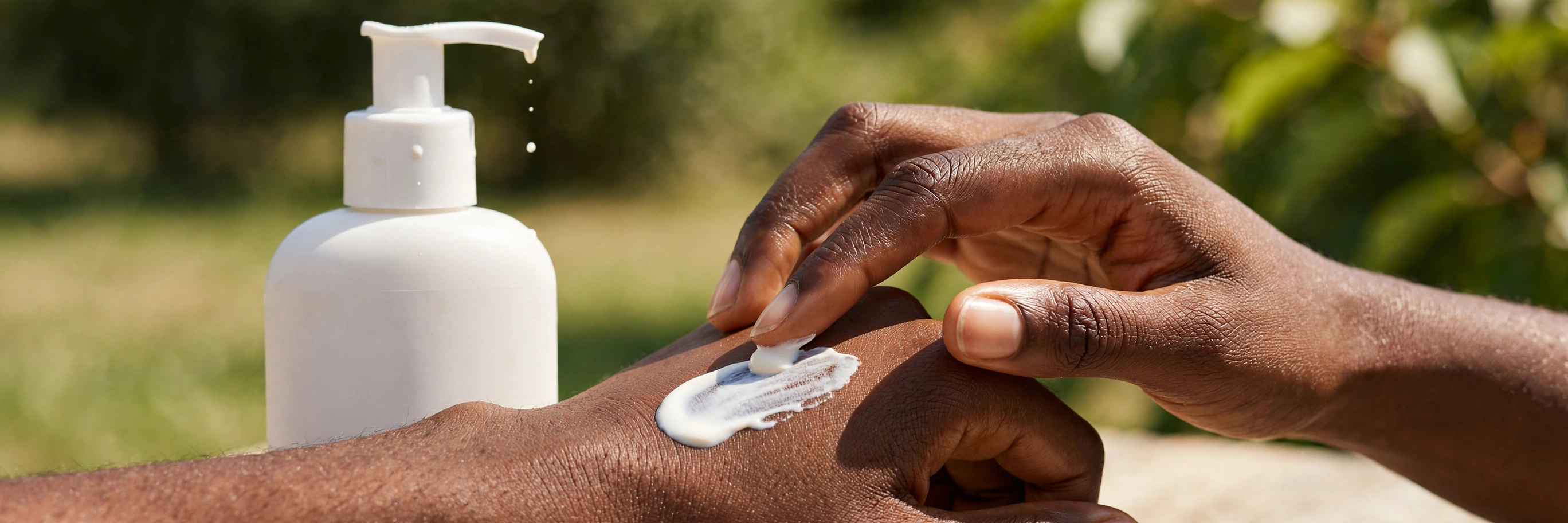
If you have melanin-rich skin, you know the drill: you find an SPF 50 that promises everything, squeeze it out, and two minutes later your face looks ashy, grey and two shades lighter than your neck. It is one of the most common reasons people with dark skin skip sunscreen — and it is exactly the problem this guide solves.
Sunscreen is non-negotiable for every skin tone. The idea that darker skin does not need SPF is one of the most damaging myths in skincare. Yes, melanin offers some natural protection — roughly equivalent to SPF 13 compared with very fair skin — but that is nowhere near the daily protection needed to prevent hyperpigmentation, melasma, premature ageing and, critically, skin cancer, which is frequently diagnosed later and at more advanced stages in darker skin.
The good news? The market has finally caught up. In 2026 there are genuinely excellent sunscreens available in the UK — on Boots, Superdrug and Cult Beauty shelves — that disappear into deep skin tones without a trace of white cast. This guide covers why sunscreen matters for dark skin, the science of white cast, UK sunscreen regulations you should know, and a comparison of the best no-white-cast picks with real £ prices.
The melanin myth is persistent: "Black don't crack, so I don't need SPF." It sounds reassuring, but dermatologists worldwide disagree. Here is the reality, plainly stated:
Melanin gives partial protection, not full protection. Darker skin (Fitzpatrick types IV–VI) has a natural sun protection factor of around 13. That means about 92% of UVB is blocked — but UVB is only part of the story. UVA, which drives premature ageing, pigmentation and contributes to skin cancer, penetrates deeply regardless of skin tone.
Hyperpigmentation hits darker skin harder. In melanin-rich skin, UV exposure triggers post-inflammatory hyperpigmentation — the stubborn dark marks left by spots, acne and even minor irritation. These marks can take months to fade, and unprotected sun exposure makes them dramatically worse. For many people with dark skin, this — not burning — is the main UV concern.
Melasma and uneven tone. Hormonal pigmentation (melasma) is more prevalent and more visible in darker skin, and UV is its primary trigger. Daily SPF is the single most effective melasma-management step.
Skin cancer is diagnosed later in dark skin. While rates are lower, acral lentiginous melanoma and other skin cancers are often caught late in Black and South Asian patients because the signs are missed and sunscreen use is low. Early detection plus prevention saves lives.
Anti-ageing. UVA breaks down collagen and elastin, causing the fine lines, sagging and dullness that everyone wants to avoid — including the readers of our guide on retinal vs retinol for wrinkles.
To choose the right sunscreen, it helps to understand what causes the grey or purple cast on dark skin:
Mineral (physical) filters — zinc oxide and titanium dioxide — sit on the skin's surface and reflect UV. They are the classic white-cast culprits: the particles are opaque and leave a chalky film, especially noticeable on deep skin tones. Modern micronised and tinted mineral formulas are better, but pure untinted mineral SPFs remain the riskiest choice for dark skin.
Chemical (organic) filters — avobenzone, octocrylene, octisalate, homosalate and the newer European filters (Tinosorb S/M, Uvinul A Plus, Mexoryl) — absorb UV rather than reflecting it, so they can be formulated to be completely invisible. Almost every sunscreen in the comparison table below uses chemical or hybrid filters for exactly this reason.
Tinted sunscreens use iron oxides to add pigment that blends with your skin tone and cancels the white cast. Iron oxides also block visible light, which matters: visible light (especially blue light) worsens melasma in darker skin. A well-matched tinted SPF is often the best option for deeper tones. One caution — most "universal tints" are designed for light-medium skin, so check shade ranges.
The UK follows the EU cosmetics regulation framework for sunscreens, and it is stricter than the US in ways that benefit you:
UVA protection is regulated. In the UK/EU, the UVA protection factor must be at least one-third of the labelled SPF, and sunscreens must display the UVA-in-a-circle logo. The US has no equivalent minimum. This means a UK SPF 50 guarantees meaningful broad-spectrum protection.
European UV filters are more advanced. Filters like Tinosorb and Mexoryl — considered gold-standard for stability and high protection — have been used in UK/EU sunscreens for years, while the US is only now catching up.
Boots star rating. Some UK sunscreens carry the Boots star-rating system (1–5 stars) measuring the ratio of UVA to UVB protection. Four or five stars indicates excellent balanced protection — a useful detail to check on the bottle.
Price and availability. Because sunscreen is a regulated cosmetic in the UK, even high-street formulas meet strict standards — you do not need to spend £30+ for effective protection. All the picks below are available from Boots, Superdrug, Cult Beauty or direct from the brand with UK shipping.
Application technique matters as much as formula:
Use enough. The testing standard is two finger-lengths (index and middle finger) for the face, or roughly a 10p-coin-sized amount. Under-applying is the top reason sunscreen underperforms.
Moisturise first if your skin runs dry. An ashy cast is often worsened by dryness. Layering over a well-formulated moisturiser — see our guide to the best moisturisers for oily skin if shine is your issue — gives chemical SPFs a smoother surface to glide on.
Wait before make-up. Give sunscreen 10–15 minutes to set before applying foundation. This prevents pilling and keeps coverage even.
Reapply. Every two hours of direct exposure, and after swimming or heavy sweating. For reapplication over make-up, an SPF mist or a powder SPF works without disturbing your base.
Year-round, not just summer. Up to 80% of UV penetrates cloud, and UVA is constant through the British winter. If you are building a winter skincare routine, SPF is still step one of the daytime routine.
Every sunscreen below was selected against three hard criteria: (1) no visible white cast on deep skin tones, (2) available in the UK at a stated £ price, and (3) SPF 50 with verified broad-spectrum/UVA protection.
Sunscreen | SPF / Filter Type | Finish on Deep Skin | Price | Where to Buy
La Roche-Posay UVMune 400 Invisible Fluid | SPF 50+, chemical (Mexoryl 400) | Completely invisible, ultra-light fluid | ~£21 | Boots, Superdrug, pharmacies
Garnier Ambre Solaire Super UV Invisible Serum | SPF 50+, chemical | Weightless serum, zero cast, make-up-friendly | ~£12 | Boots, Superdrug
Nivea Sun UV Face Shine Control SPF 50 | SPF 50, chemical | Matte-ish, no cast, great under make-up | ~£8 | Boots, Superdrug
Bondi Sands Fragrance Free Face Fluid SPF 50+ | SPF 50+, chemical | Fluid texture, blends fully, no grey tone | ~£9 | Boots, Superdrug
Eucerin Sun Oil Control Gel-Crème SPF 50+ | SPF 50+, chemical | Dry-touch gel, ideal for oily/combination skin | ~£15 | Boots, pharmacies
Black Girl Sunscreen SPF 30 (import via Cult Beauty) | SPF 30, chemical | Made for melanin-rich skin, moisturising, zero cast | ~£19 | Cult Beauty
Altruist Dermatologist Sunscreen SPF 50 | SPF 50, chemical (Tinosorb) | Lightweight, no cast, incredible value | ~£4–£5 | Amazon UK, brand site
CeraVe Invisible Mineral Sunscreen Stick SPF 50* | SPF 50, mineral (tinted) | Tinted to cancel cast — check shade match | ~£14 | Boots, cerave.co.uk
\*Mineral option included for those avoiding chemical filters; tinted minerals are the only mineral formulas reliably cast-free on dark skin. See our mineral vs chemical sunscreen comparison for the full breakdown.
Best overall: La Roche-Posay UVMune 400 — the Mexoryl 400 filter gives best-in-class UVA protection and the fluid truly disappears on deep skin.
Best budget: Altruist SPF 50 at ~£4–£5 is dermatologist-developed, Tinosorb-based and cast-free. Unbeatable value.
Best for oily skin: Eucerin Oil Control or Nivea Shine Control — both dry down without the grease that can make casts look worse.
Best for dry skin: Black Girl Sunscreen SPF 30 doubles as a moisturiser with shea and jojoba.
Best under make-up: Garnier Super UV Invisible Serum — the serum texture layers beautifully under foundation.
Best mineral option: CeraVe Invisible Mineral Stick in the tinted version, applied over moisturiser.
If dark marks are your main concern, sunscreen is your treatment's best friend. Pigment-fading actives — vitamin C, niacinamide, azelaic acid, tranexamic acid — all work dramatically better when UV is blocked daily, because UV is constantly re-triggering the pigment. Our guide on whether you can combine niacinamide and vitamin C explains how to layer these brightening ingredients safely.
A simple hyperpigmentation routine for dark skin:
AM: gentle cleanser → vitamin C serum → niacinamide serum → moisturiser → SPF 50 (two finger-lengths).
PM: double cleanse → treatment (azelaic acid or tranexamic acid) → moisturiser.
Weekly: gentle exfoliation — but read our guidance on mixing AHA/BHA with retinol before combining acids with strong actives.
The British Association of Dermatologists recommends daily broad-spectrum sunscreen for all skin types, and their guidance is clear that darker skin tones are not exempt — particularly given the hyperpigmentation burden and late-diagnosis skin cancer risk. If you want an authoritative overview of sunscreen safety and the evidence behind daily use, the NHS sunscreen guidance and the British Association of Dermatologists' sun protection advice are the UK gold standards. For the science on visible light and melasma, iron-oxide tinted sunscreens have been shown in peer-reviewed studies — see for example research indexed on PubMed — to reduce melasma relapse when combined with UV protection.
Using an SPF moisturiser as your only protection. Most SPF moisturisers are SPF 15–30 and are applied too thinly to reach the labelled protection. Use a dedicated SPF 50.
Skipping reapplication. One morning application does not cover a full day outdoors.
Trusting "universal tint" blindly. Swatch tinted SPFs on your jawline in daylight — many run light.
Forgetting ears, neck and the back of the hands. These show ageing and pigment changes first.
Assuming foundation with SPF is enough. You would need roughly seven times the normal amount of foundation to reach its stated SPF.
Yes. Melanin provides roughly SPF 13 of natural protection — far below the SPF 50 dermatologists recommend. Dark skin is still vulnerable to hyperpigmentation, melasma, photoageing and skin cancer, all of which sunscreen prevents.
The La Roche-Posay UVMune 400 Invisible Fluid (~£21, Boots/Superdrug) is the top pick for 2026: completely invisible on deep skin tones with best-in-class UVA protection. For a budget option, Altruist SPF 50 (~£4–£5) is excellent and cast-free.
Chemical (organic) sunscreens are generally better for dark skin because they absorb UV invisibly rather than sitting on the skin as an opaque white film. Modern European chemical filters (Tinosorb, Mexoryl) are photostable, highly protective and available in UK formulas.
No — the opposite is true. Unprotected UV exposure is one of the main triggers of hyperpigmentation and melasma in dark skin. Sunscreen prevents and helps fade dark marks, especially when combined with brightening ingredients like vitamin C and niacinamide.
Two full finger-lengths (index and middle finger) for the face and neck — roughly a 10p-coin-sized amount. Most people apply far less, which cuts the real-world protection dramatically.
Yes. Check the PAO (period-after-opening) symbol — usually 12 months for sunscreens. Expired sunscreen loses efficacy, so replace your bottle each year.
You can in a pinch, but face formulas are designed to be non-comedogenic and cosmetically elegant. Body sunscreens can feel heavy, cause breakouts on the face and leave a worse cast. A dedicated face SPF is worth it.
Yes — it is stocked by Cult Beauty with UK delivery (~£19). It was specifically formulated for melanin-rich skin and leaves zero white cast.
Dark skin needs daily SPF 50 — melanin's natural ~SPF 13 is not enough to prevent hyperpigmentation, melasma, ageing or skin cancer.
Choose chemical (organic) or tinted mineral formulas to avoid white cast; modern European filters disappear completely on deep skin.
UK sunscreens guarantee strong UVA protection by regulation — look for the UVA circle logo and the Boots star rating.
Top 2026 picks: La Roche-Posay UVMune 400 (~£21) for best overall, Altruist SPF 50 (~£4–£5) for best budget, Black Girl Sunscreen (~£19) for dry skin.
Apply two finger-lengths, reapply every two hours outdoors, and wear SPF year-round — even through a British winter.
For hyperpigmentation, sunscreen is the foundation — pair it with vitamin C and niacinamide for faster fading.
The white-cast era is over. In 2026 there is no reason for anyone with dark skin in the UK to skip sunscreen — the formulas exist, they are affordable (starting at ~£4), and they are on high-street shelves. Pick one from the table above, apply generously every morning, and your skin will thank you for decades: fewer dark marks, more even tone, and real protection against the damage you cannot see. If hyperpigmentation is your main battle, sunscreen is not optional — it is the treatment.
Retinol and niacinamide routine order explained: which goes first, AM vs PM layering, the sandwich method, UK product picks and beginner schedules.
Read More arrow_forward
Peptides vs retinol for beginners: which is right for you? This UK comparison covers effectiveness, side effects, costs, and a beginner routine for each.
Read More arrow_forward
Pregnancy-safe skincare UK guide: ingredients to avoid (retinoids, salicylic acid), NHS-aligned safe swaps, and a trimester routine with £ prices.
Read More arrow_forward
Can you use niacinamide and vitamin C together? Yes — the old myth is debunked. Here's the UK guide to layering them safely for brighter, calmer skin.
Read More arrow_forward
Can you mix AHA/BHA with retinol? Yes — with the right method. This UK guide covers safe layering, AM/PM routines, and who should avoid the combo.
Read More arrow_forwardCalculate your Body Mass Index (BMI) in seconds. BMI is a quick screening number…
Use now arrow_forwardFind your daily calorie needs based on your age, sex, height, weight and activit…
Use now arrow_forwardFind how much water you should drink each day, in litres and glasses, based on y…
Use now arrow_forward