Fungal Acne (Malassezia) Routine: Safe Treatment Guide for UK Skin (2026)
Fungal acne isn't real acne — it's a yeast overgrowth. Learn how to spot it, the exact antifungal routine, and the best UK products to clear it safely.
Read More arrow_forwardSkincare for women over 50: the definitive UK guide to menopause skin changes, firmness, dryness and age spots — with AM/PM routines and £ product picks.
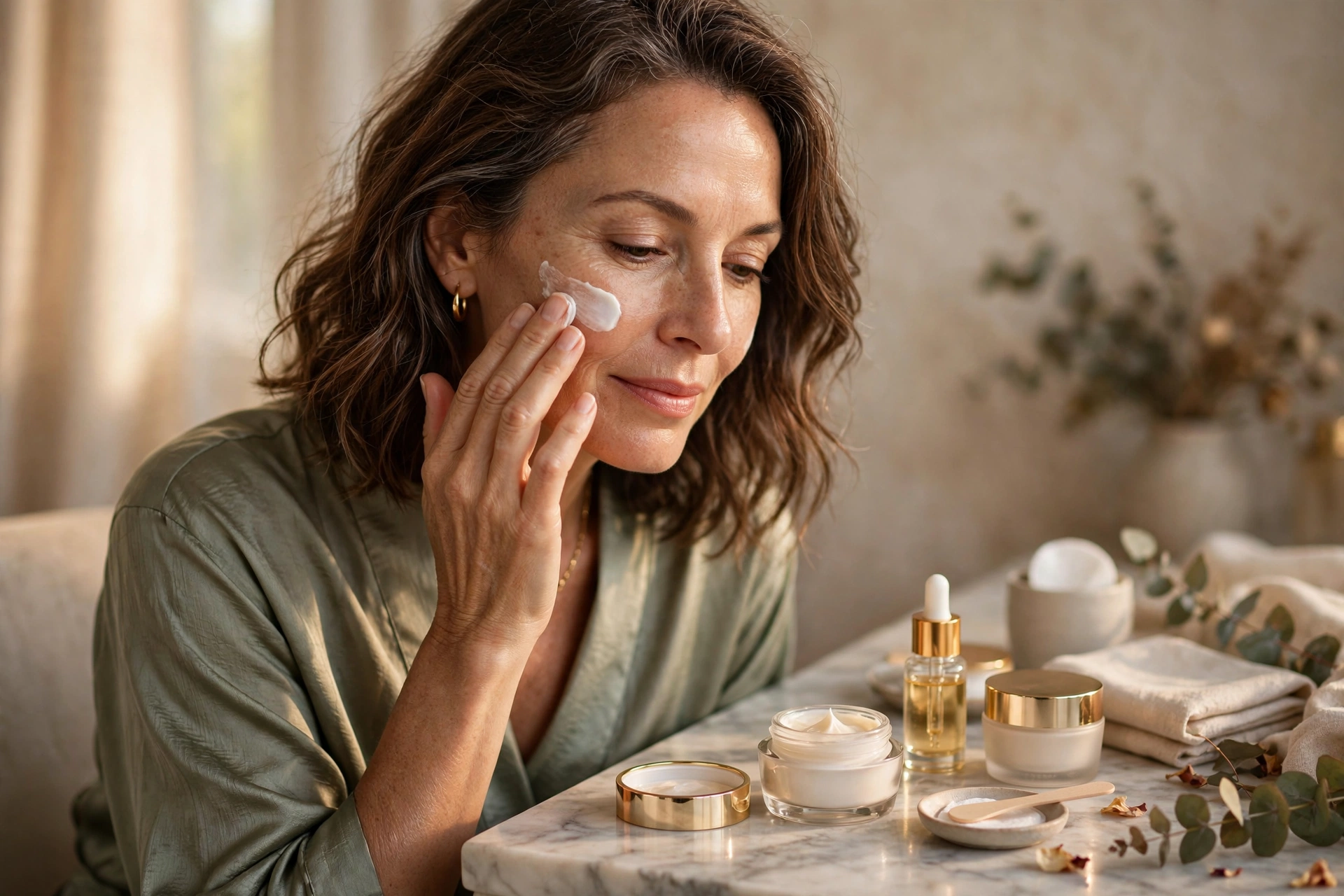
If you're over 50 and your skin no longer behaves the way it did at 35, you're not imagining it — and you're certainly not alone. Around the menopause, falling oestrogen levels trigger a cascade of changes in the skin: collagen production drops by as much as 30% in the first five years after menopause, the skin thins, oil glands slow down, and moisture loss accelerates. The result? Increased dryness, loss of firmness and elasticity, deeper lines, age spots, a duller tone and skin that simply takes longer to bounce back.
Here's the good news: none of this is a lost cause. Modern skincare science offers genuinely effective, evidence-backed ingredients for mature skin — retinoids that rebuild collagen, peptides that support firmness, ceramides that repair the barrier, and sunscreens that prevent further damage. The key is using the right ingredients, in the right order, at the right strengths — and avoiding the harsh, over-exfoliating routines designed for twenty-somethings that can make mature skin worse.
This guide is written specifically for women over 50 in the UK. It covers exactly what happens to your skin during and after menopause, the hero ingredients worth your money (and the ones that aren't), complete morning and evening routines, the best UK-available products with real £ prices from Boots, Superdrug and Cult Beauty, and answers to the questions we hear most often.
Understanding the "why" helps you choose the right "what." Oestrogen receptors are found throughout the skin, and when oestrogen declines, several things happen simultaneously:
Collagen loss accelerates. Collagen — the protein that keeps skin firm and plump — declines by roughly 2% per year after the menopause, with the steepest drop in the first five years. This is what causes sagging along the jawline, deeper nasolabial folds and that general loss of "bounce."
The skin barrier weakens. Ceramide and lipid production falls, so skin loses moisture faster and becomes more reactive. Products that never bothered you before may suddenly sting — this is normal and manageable, not a sign that your skin is "damaged."
Oil production drops. Sebaceous glands slow down, which means less natural lubrication. Many women who were combination or oily for decades suddenly find themselves dry, especially on the cheeks.
Pigmentation increases. Years of cumulative sun exposure surface as age spots and uneven tone, and hormonal shifts can make pigmentation more stubborn.
Healing slows. Cell turnover — the rate at which your skin renews itself — drops from around 28 days in your twenties to 45–60 days or more after 50. Marks, spots and irritation simply take longer to resolve.
The NHS menopause overview confirms that skin and hair changes are among the recognised symptoms of menopause, and dermatologists note that these changes respond well to targeted topical care — which is exactly what this guide delivers.
Not every trending ingredient deserves a place in a mature-skin routine. These are the ones with the strongest evidence and the best track record for women over 50:
No other skincare ingredient has as much clinical evidence for ageing skin as the retinoid family. Retinoids speed up cell turnover, stimulate collagen production, fade pigmentation and smooth texture. For over-50 skin, they're the single highest-impact addition you can make.
Retinol (0.3–1%) is the classic over-the-counter option — effective and widely available.
Retinal (retinaldehyde) works faster than retinol with less irritation, making it ideal for mature beginners. Our comparison of retinal vs retinol for wrinkles explains which suits your skin.
Tretinoin is prescription-only in the UK and the strongest option — discuss it with your GP or a dermatologist if over-the-counter retinoids aren't enough.
Start low (0.3% retinol or low-strength retinal), use it 2–3 evenings per week, and build up over 2–3 months. Always follow with moisturiser, and never skip morning sunscreen — retinoids increase sun sensitivity significantly.
Peptides are short chains of amino acids that signal the skin to produce more collagen. They're gentler than retinoids and an excellent daytime partner to a nighttime retinoid. Look for products containing Matrixyl (palmitoyl pentapeptide), copper peptides or Argireline. They won't deliver retinoid-level transformation, but they meaningfully support firmness and are very well tolerated.
With natural ceramide production declining after 50, replenishing them topically is one of the smartest moves you can make. Ceramide-rich moisturisers reduce dryness, calm reactivity and make every other active in your routine work better. If your skin feels tight, flaky or easily irritated, prioritise ceramides before adding stronger actives — our guide to repairing a damaged skin barrier explains the recovery process in detail.
Niacinamide strengthens the barrier, evens tone, refines enlarged pores and calms redness — all concerns that intensify after 50. At 4–5% it's gentle enough for daily use; at 10% it's more potent but can irritate very dry skin, so start lower. It layers beautifully with almost everything.
L-ascorbic acid (10–20%) is a proven antioxidant that brightens dull skin, fades age spots and supports collagen synthesis. Use it in the morning under sunscreen for a powerful protective-brightening combination. If pure vitamin C irritates you, gentler derivatives like ascorbyl glucoside still deliver meaningful benefits.
Hyaluronic acid draws moisture into the skin — particularly valuable when your skin's own water-retention capacity has declined. Apply it to damp skin and seal it in with moisturiser. It's not anti-ageing in itself, but hydrated skin looks plumper, smoother and more radiant immediately.
Up to 80% of visible skin ageing is caused by UV exposure — and it's never too late to start protecting. UK rules require broad-spectrum protection labelling, so look for SPF 50 with high UVA protection (the star rating or "UVA" in a circle). Our roundup of the best sunscreens for 2026 covers mineral and chemical options suited to mature skin.
Keep mornings protective and simple — four to five steps is plenty:
Gentle cleanser — a creamy, non-foaming cleanser. In the morning you only need to remove overnight products and a little oil; harsh cleansing strips already-dry skin.
Vitamin C serum — apply to dry skin, wait a minute to absorb.
Peptide or niacinamide serum — layer over the vitamin C (or use on alternate mornings if your skin prefers simplicity).
Moisturiser with ceramides — lock everything in with a rich, barrier-supporting cream.
SPF 50 sunscreen — every single morning, year-round, even in a British winter. UVA penetrates cloud and glass.
Total routine time: under 5 minutes.
Evenings are for treatment and repair:
Cleanser — if you wear makeup or SPF (you should), consider the double-cleanse method: an oil or balm first, then your gentle cream cleanser.
Retinoid (2–3 evenings per week) — pea-sized amount for the whole face, avoiding the immediate eye area. On non-retinoid nights, use a peptide or hydrating serum instead.
Eye cream (optional but worthwhile) — the eye area shows ageing first. Look for caffeine for puffiness or peptides for lines — our picks for caffeine eye serums for dark circles include budget-friendly UK options.
Rich night moisturiser or facial oil — seal in your treatments with something nourishing. Squalane, rosehip or evening primrose oils are lovely for mature skin.
Weekly treatment (1–2 times) — a gentle exfoliating treatment keeps cell turnover moving. A mild lactic acid product or enzyme mask is kinder than strong glycolic peels for most over-50 skin.
Mistake 1: Using the same routine as your 30s. Skin at 55 has fundamentally different needs from skin at 35. Heavy exfoliation, strong astringent toners and lightweight gel moisturisers that worked decades ago will now leave skin parched and irritated. Upgrade to richer textures and gentler actives.
Mistake 2: Skipping sunscreen "because it's cloudy." The UK's UV index may be low in winter, but UVA — the ageing ray — is present year-round and penetrates cloud cover. Every day you skip SPF is a day your other products fight an uphill battle.
Mistake 3: Starting retinoids too strong, too fast. Jumping straight to 1% retinol nightly is the fastest route to a red, peeling face and an abandoned bottle. Start at 0.3%, twice a week, and build slowly. Patience delivers results; impatience delivers irritation.
Mistake 4: Exfoliating aggressively. Daily scrubs, strong peels and layered acids thin an already-thinning barrier. Mature skin needs gentle, infrequent exfoliation — think weekly, not daily.
Mistake 5: Neglecting the neck, chest and hands. These areas show age just as fast as the face and are almost always under-treated. Extend your serums, moisturiser and — critically — sunscreen down your neck and onto your chest and hands every day.
Mistake 6: Expecting overnight miracles. Cell turnover after 50 takes 45–60 days. Judge any new routine after 8–12 weeks, not 8–12 days. The women who get the best results are the consistent ones, not the ones chasing the newest launch.
Real products, real £ prices, all available at Boots, Superdrug or Cult Beauty right now:
CeraVe Hydrating Cleanser — ~£10 (Boots, Superdrug): creamy, ceramide-rich, fragrance-free. The perfect mature-skin morning cleanser.
The Body Shop Camomile Cleansing Butter — ~£13 (Boots): a gentle first cleanse that melts makeup and SPF without stripping.
The Ordinary Retinol 0.5% in Squalane — ~£6 (Boots, Superdrug, Cult Beauty): unbeatable value starter retinoid; the squalane base buffers irritation.
Medik8 Crystal Retinal 6 — ~£45 (Cult Beauty, Lookfantastic): retinaldehyde in a stabilised formula — faster results than retinol with excellent tolerability. The "6" is the mid-strength; beginners should start with Crystal Retinal 3 (~£39).
La Roche-Posay Redermic R — ~£45 (Boots): a pharmacy-grade retinol with a strong clinical pedigree, widely recommended by UK dermatologists.
The Ordinary "Buffet" + Copper Peptides 1% — ~£29 (Boots, Superdrug, Cult Beauty): copper peptides plus multiple peptide complexes — a firmness-focused powerhouse at a fair price.
No7 Restore & Renew Face & Neck Multi Action Serum — ~£35 (Boots): No7's menopause-targeted range is formulated specifically for oestrogen-depleted skin and consistently wins UK beauty awards.
CeraVe Moisturising Cream — ~£12 (Boots, Superdrug): three essential ceramides plus hyaluronic acid. Rich enough for dry mature skin, cheap enough to use generously on neck and chest.
Eucerin Hyaluron-Filler Day Cream SPF 30 — ~£25 (Boots): hyaluronic acid plus sun protection in one step — ideal for women who want a streamlined morning routine.
Weleda Skin Food — ~£10 (Boots, Superdrug): a cult rich cream for very dry skin; brilliant as a night cream or winter barrier.
La Roche-Posay Anthelios UVMune 400 SPF 50+ — ~£19 (Boots): the UK dermatologist favourite — exceptional UVA protection, elegant texture, widely available.
Garnier Ambre Solaire Super UV SPF 50+ — ~£10 (Boots, Superdrug): a budget hero with high protection; the invisible version suits mature skin beautifully.
The Ordinary Niacinamide 10% + Zinc 1% — ~£6 (Boots, Superdrug): pore-refining and tone-evening on a budget (patch test first if very dry).
The Inkey List Vitamin C Cream — ~£11 (Boots, Superdrug, Cult Beauty): a gentle, stable vitamin C option for brightening without irritation.
Product | Active & strength | Best for | Price (UK)
The Ordinary Retinol 0.5% in Squalane | 0.5% retinol | Absolute beginners, tight budgets | ~£6
Medik8 Crystal Retinal 3 | 0.03% retinal | Beginners wanting faster results | ~£39
La Roche-Posay Redermic R | Pure retinol | Pharmacy-grade reliability | ~£45
Medik8 Crystal Retinal 6 | 0.06% retinal | Graduating from beginner formulas | ~£45
Prescription tretinoin | 0.025–0.05% tretinoic acid | Via GP/dermatologist when OTC isn't enough | Prescription
Start at the top of the table and work down only when your skin asks for more — not when your impatience does.
It's never too late. Clinical studies show retinoids improve collagen production, texture and pigmentation even in skin that's never been treated before. Start with a low-strength retinol (0.3%) or retinal, use it 2–3 evenings per week, moisturise well, and wear daily SPF. Most women see visible improvement within 8–12 weeks. The British Association of Dermatologists notes that topical retinoids are among the best-evidenced treatments for photoaged skin.
Yes, but gently and infrequently. Cell turnover slows with age, so mild exfoliation helps — but aggressive exfoliation damages an already-thinning barrier. A gentle lactic acid product or enzyme exfoliant once a week is plenty for most over-50 skin. Skip harsh scrubs and high-strength peels entirely.
Look for rich creams containing ceramides, hyaluronic acid and squalane — CeraVe Moisturising Cream (~£12) and Eucerin Hyaluron-Filler (~£25) are excellent UK-available options. The best moisturiser is the one you'll use generously twice a day; don't ration a premium cream when a £12 workhorse does the job.
Honest answer: skincare can improve firmness, texture and tone meaningfully — retinoids and peptides genuinely stimulate collagen — but no cream can replicate the lifting effect of procedures like radiofrequency or surgery once significant laxity has set in. Think of skincare as maximising what you have and slowing further decline; for dramatic lifting, consult a qualified practitioner.
Yes. UVA rays — the ones responsible for most visible ageing — are present all year, penetrate cloud and even glass, and accumulate damage silently. UK labelling rules make it easy to choose well: look for SPF 50 with the UVA-in-a-circle symbol or a 5-star UVA rating. Research indexed on PubMed consistently shows daily sunscreen use prevents further photoageing at any age.
Fragrance (including essential oils), high-percentage acids, alcohol-heavy toners and physical scrubs are the usual culprits. Simplify to a gentle cleanser, a ceramide moisturiser and sunscreen while your barrier recovers, then reintroduce one active at a time. Niacinamide at 4–5% is one of the best-tolerated actives for newly sensitive mature skin.
Sometimes — but price is a poor proxy for efficacy. A £6 retinoid from The Ordinary has more evidence behind it than many £150 "miracle" creams. Spend your money where the science is: retinoids, vitamin C, sunscreen and ceramides. Save on cleansers and basic moisturisers, where budget options perform identically.
For hydration and glow: days. For texture and tone: 4–6 weeks. For firmness, fine lines and pigmentation: 8–12 weeks minimum, because that's how long mature skin takes to turn over and rebuild collagen. Take a photo in the same lighting on day one and again at 12 weeks — the difference is often more dramatic than the mirror suggests.
Menopause skin changes are hormonal and normal — collagen drops, barrier weakens, dryness and pigmentation increase. Targeted skincare genuinely helps.
Retinoids are the #1 evidence-backed ingredient for over-50 skin — start low (0.3% retinol), go slow, always pair with morning SPF.
Support actives matter: peptides for firmness, ceramides for barrier repair, niacinamide for tone, vitamin C for brightness, hyaluronic acid for hydration.
Sunscreen is non-negotiable — SPF 50 with high UVA protection, every morning, year-round in the UK.
Keep it simple: gentle cleanser, treatment serum, rich moisturiser, SPF. Extend everything to neck, chest and hands.
Budget works: The Ordinary Retinol 0.5% (~£6), CeraVe Moisturising Cream (~£12) and Garnier Ambre Solaire SPF 50+ (~£10) cover the essentials for under £30.
Be patient: judge results at 8–12 weeks, not 8–12 days.
Skincare for women over 50 isn't about chasing youth — it's about giving your skin exactly what menopause took away: collagen support, barrier lipids, deep hydration and daily protection. You don't need a twelve-step routine or a £200 cream. You need a retinoid used consistently, a ceramide-rich moisturiser, vitamin C in the morning, and sunscreen every single day.
Start tonight: pick one retinoid, one good moisturiser and one sunscreen from the lists above, and commit to the simple routines in this guide for twelve weeks. Your skin has carried you this far — with the right care, its best decade might still be ahead of it.
Fungal acne isn't real acne — it's a yeast overgrowth. Learn how to spot it, the exact antifungal routine, and the best UK products to clear it safely.
Read More arrow_forwardCalculate your Body Mass Index (BMI) in seconds. BMI is a quick screening number…
Use now arrow_forwardFind your daily calorie needs based on your age, sex, height, weight and activit…
Use now arrow_forwardFind how much water you should drink each day, in litres and glasses, based on y…
Use now arrow_forward