Can You Use Bakuchiol and Vitamin C Together UK? A Gentle Glow Guide
A gentle UK guide to pairing bakuchiol with vitamin C: layering order, AM/PM routines, who should avoid it, and how to get glow without irritation.
Read More arrow_forwardCan copper peptides and vitamin C be layered safely? A UK firming guide on order, routines, and who should skip the mix.
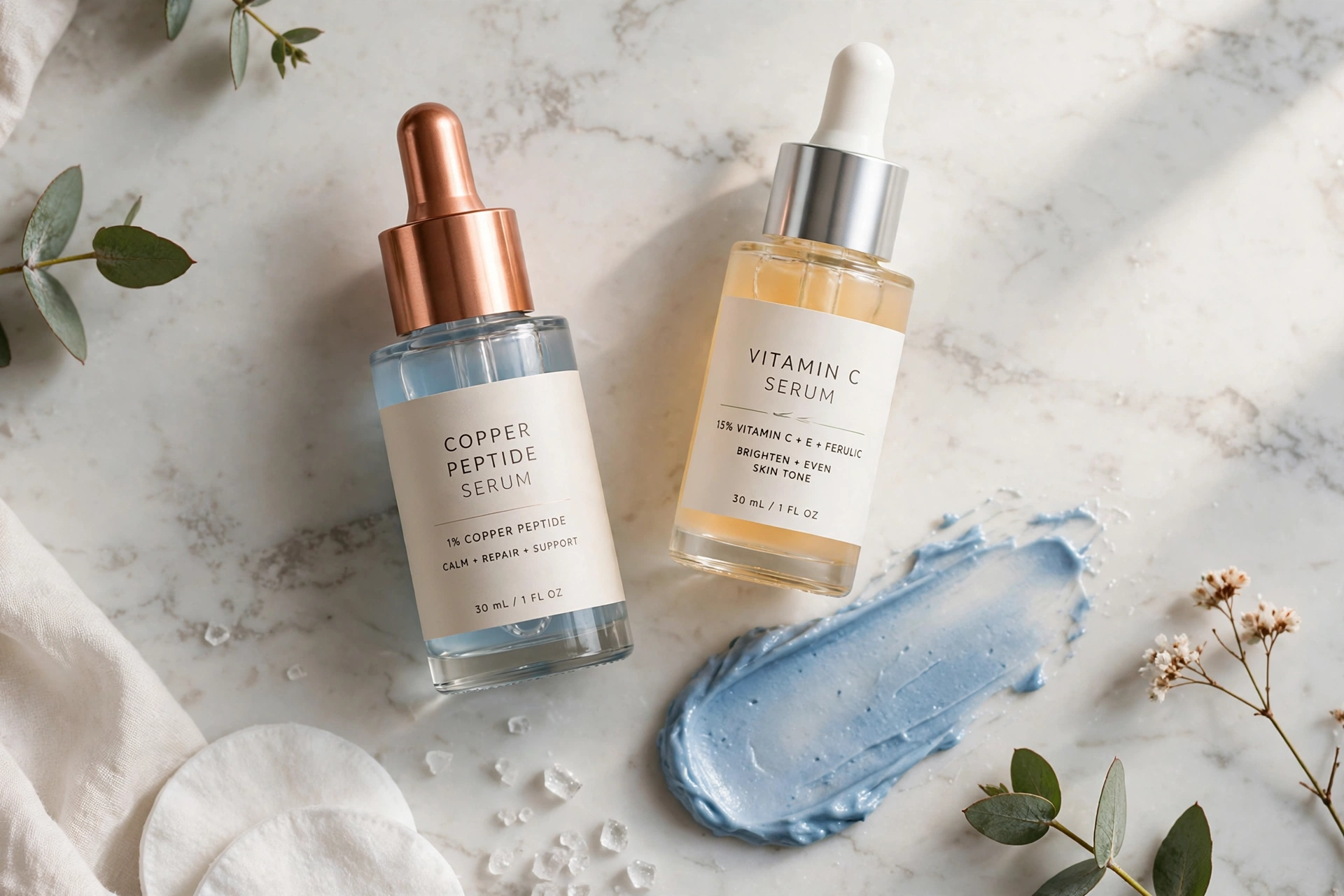
If you have been building a firming routine, the question can you use copper peptides and vitamin c together uk shoppers keep asking is a sensible one, because both ingredients promise brighter, firmer-looking skin, yet old skincare advice warned against mixing them. The short version is encouraging: most people can use both, provided they are separated wisely, introduced slowly, and chosen in formulas that suit their skin type and the British climate. This guide explains what each ingredient actually does, whether they clash in the bottle or on the skin, the order to apply them, a realistic morning and evening routine, and who should pause before combining them. It is written for UK readers, with high-street and online availability, typical prices in pounds, and the practical realities of cold, damp winters and often hard water, all of which affect how skin behaves.
Copper peptides and vitamin C work in different ways, which is exactly why pairing them is tempting. Copper peptides are signal peptides, most famously GHK-Cu, that are thought to support the skin's natural repair processes and the appearance of firmness and elasticity. Vitamin C, usually as L-ascorbic acid or a gentler derivative, is an antioxidant that helps defend against environmental damage, supports a more even skin tone, and contributes to collagen synthesis. Used separately, each has a loyal following. Used together, they can address dullness, fine lines, loss of firmness, and uneven tone at the same time, but only if irritation is kept under control. Irritation, not a dramatic chemical explosion, is the real risk, and it is the reason this guide favours separation over stacking everything at once.
## What Copper Peptides Do for Skin
Copper peptides are best understood as messengers. In healthy skin, small peptide fragments help signal repair after everyday damage from sun, pollution, and friction. A copper peptide serum aims to mimic that signalling, encouraging skin to look smoother, plumper, and more resilient over time. Many users report that skin feels bouncier and that fine lines look softened after eight to twelve weeks of consistent use, although results vary and no topical product can rebuild skin overnight. Copper peptides are generally considered gentler than strong retinoids or high-strength acids, which makes them appealing for people in their thirties, forties, and beyond who want firming support without peeling.
In the UK, copper peptide serums are widely available from brands sold at Cult Beauty and through specialist online retailers, with typical prices ranging from about £20 to £70 depending on concentration and brand. Look for a serum rather than a heavy cream if you want to layer it easily, and check whether the formula also contains hydrating ingredients such as glycerin, hyaluronic acid, or squalane. Those supporting ingredients matter in a UK winter, when central heating and cold wind can leave skin tight. Avoid pairing a new copper peptide product with a strong exfoliating acid on the same night at first, because too many actives at once is the fastest route to redness, even when each product is fine on its own. Patch testing on the jawline for a few days is a small step that prevents a week of recovery.
### Who Benefits Most From Copper Peptides
People noticing early loss of firmness, fine lines around the eyes and mouth, or skin that looks tired rather than damaged often enjoy copper peptides most. They are also a useful option for those who cannot tolerate retinol every night, or who want a firming step that does not increase sun sensitivity in the same way. Mature skin, skin recovering from over-exfoliation, and skin that feels thin or crepey can all benefit from the hydrating, supportive character of a well-formulated peptide serum. That said, copper peptides are not a substitute for sunscreen, and they will not replace treatments for significant medical skin conditions. If you have a diagnosed condition, persistent redness, or a rash that does not settle, see a GP or dermatologist rather than adding more actives.
### How to Choose a Copper Peptide Product in the UK
Choose a product that states its peptide type clearly, ideally GHK-Cu, and that comes in opaque or airless packaging to protect the formula. A concentration around 1 to 2 percent is a sensible starting point for most people, and a serum texture usually layers better under moisturiser than a thick cream. In the UK, check availability at Boots, Superdrug, and Cult Beauty, but also check the brand's own UK website, because some peptide serums are online-only and may carry delivery charges. Store the product away from radiators and steamy bathrooms, use clean hands, and do not decant it into another container, because contamination and oxidation reduce effectiveness. If a serum changes colour dramatically, smells metallic in an unpleasant way, or separates, it is time to replace it.
## What Vitamin C Does for Skin
Vitamin C is one of the most researched skincare antioxidants. It helps neutralise free radicals generated by ultraviolet light and pollution, supports collagen production, and can reduce the appearance of dark spots and dullness with regular use. Many UK users reach for it in the morning, because antioxidant protection pairs naturally with sunscreen during the day. The classic form, L-ascorbic acid, is potent but can sting, especially at strengths above 15 percent, and it oxidises when exposed to light and air. Derivatives such as sodium ascorbyl phosphate, ascorbyl glucoside, and ethyl ascorbic acid are gentler and more stable, making them popular choices for sensitive skin and for beginners.
In UK shops, vitamin C serums are easy to find at Boots and Superdrug, with typical prices from about £10 for a basic high-street serum to £80 or more for a premium, stabilised formula. A strength of 10 to 15 percent L-ascorbic acid, or an equivalent derivative dose, is enough for most people, and higher is not automatically better. Signs that a vitamin C product has oxidised include a dark orange or brown colour and a hot, metallic smell; an oxidised serum is less effective and more likely to irritate. Keep vitamin C in a cool, dark place, close the cap promptly, and prefer pump or dropper bottles that limit air exposure. For more background on choosing reputable information about skin conditions, the [British Association of Dermatologists](https://www.bad.org.uk/) provides patient information leaflets written for the UK public.
### L-Ascorbic Acid Versus Derivatives
The choice between pure L-ascorbic acid and a derivative is really a choice between potency and comfort. L-ascorbic acid works at a low pH, which helps it penetrate but also makes stinging, redness, and dryness more likely, particularly in cold weather. Derivatives work at a gentler pH and convert to active vitamin C in the skin, so they tend to suit sensitive, rosacea-prone, or barrier-compromised skin. If you have never used vitamin C before, starting with a derivative for four to six weeks lets you learn how your skin responds before deciding whether to try a stronger formula. If you already tolerate L-ascorbic acid well, there is no need to switch; consistency matters more than chasing the strongest percentage on the shelf.
### Vitamin C and UK Sun Protection Rules
In the UK, sunscreens are regulated as cosmetic products and must meet specific labelling and testing standards, which is reassuring when you are pairing an antioxidant with daily SPF. Vitamin C does not replace sunscreen, and it does not make skin sun-proof, but morning antioxidant use plus a broad-spectrum SPF 30 or SPF 50 is a strong daytime combination. Apply vitamin C first, let it absorb for a minute, then apply moisturiser and sunscreen. In winter, many people in the UK skip sunscreen on grey days, yet ultraviolet light still reaches skin through cloud, so a daily SPF remains worthwhile, especially if you are using brightening actives. For general guidance on skin conditions and when to seek care, the [NHS conditions pages](https://www.nhs.uk/conditions/) are a useful first stop.
## can you use copper peptides and vitamin c together uk? The Short Answer
Yes, most people can use both, but the safest method is not to mix them in your palm or layer them wet-on-wet in the same routine at first. The old warning came from a chemistry concern: copper ions can oxidise vitamin C, potentially reducing its potency, and combining two potent actives at once can irritate skin. Modern formulas are more stable than the early products that prompted that warning, and many people now use both successfully by separating them by time of day. Think of it as teamwork with shifts rather than a single crowded shift. Vitamin C takes the morning, copper peptides take the evening, and each gets space to work without competing or irritating the skin barrier.
That separation approach also solves the pH question. Pure L-ascorbic acid prefers a low, acidic pH, while copper peptides prefer a more neutral environment. Applying them seconds apart can mean neither sits at its ideal pH, and the skin gets two stimulating signals at once. Giving them different routines removes that compromise entirely. If you use a gentle vitamin C derivative rather than pure L-ascorbic acid, layering in the same routine becomes more forgiving, because derivatives are less pH-sensitive and less likely to sting. Even then, start with alternate days, watch for redness or tightness for two weeks, and only then consider same-routine layering if your skin is calm. Readers comparing other pairings will find the same separation principle in our guide to [ingredient combinations that work well together](https://www.glowmagzine.com/blog/skincare-ingredient-combinations-guide-uk/), which explains why timing often matters more than the ingredients themselves.
### Can You Mix Them in the Same Bottle or Palm?
Do not mix a copper peptide serum and a vitamin C serum together in your palm, in a bottle, or in a homemade blend. Mixing changes concentrations, exposes both formulas to air, and makes it impossible to know which product caused irritation if your skin reacts. It can also waste expensive products, because a mixed puddle oxidises faster than either product in its own sealed bottle. The same caution applies to "cocktailing" several serums at once in pursuit of faster results. Skincare rewards patience and clear variables: one new product at a time, one routine change at a time, and notes on how skin responds. If a brand sells a single product that already contains both copper peptides and a vitamin C derivative, that is different, because the manufacturer has tested that specific combination for stability. A ready-made combined formula is a reasonable shortcut, provided you patch test it first.
### Signs the Combination Is Working
Progress with firming and brightening ingredients is gradual. In the first two weeks, look for better hydration and a slightly smoother makeup application rather than dramatic firming. By four to six weeks, tone often looks more even and skin may feel springier to the touch. By eight to twelve weeks, fine lines can look softened in good light, and photographs taken in the same lighting can help you judge fairly. Keep expectations honest: topical products improve appearance, they do not lift skin like a procedure, and genetics, sun history, sleep, and smoking all influence results. If skin becomes persistently red, flaky, or sore, that is not "purging" from these ingredients; it is irritation, and the kindest response is to pause one product, simplify to cleanser, moisturiser, and sunscreen, and reintroduce slowly once calm.
## Order of Application: How to Layer Them Safely
If you do layer them in the same routine, order follows texture and pH. Apply the thinnest, most watery product first, wait sixty to ninety seconds, then apply the next product, and finish with moisturiser. For most people that means vitamin C first in the morning, because it is usually a lightweight serum, followed by a hydrating serum if used, then moisturiser and sunscreen. In the evening, copper peptides usually come after cleansing and any hydrating toner, before a richer moisturiser. Never apply a peptide serum over a thick cream and expect it to penetrate well, and never rush layers while skin is still dripping wet, because that can increase stinging.
A practical rule for beginners is the split-routine method, and it is the method this guide recommends for the first month. Use vitamin C in the morning and copper peptides at night, on alternate nights at first if your skin is sensitive. After a month of calm skin, you can experiment with using copper peptides in the morning on days you skip vitamin C, or using a gentle derivative alongside peptides in the evening. Keep a simple log for the first month: product, time of day, and any redness or dryness the next morning. That log is more useful than any online review, because it records your skin, your water, your heating, and your climate, not someone else's. If irritation appears, step back to the split routine rather than pushing through, and remember that repairing the barrier first will make every other active work better. Our guide to [repairing a damaged skin barrier](https://www.glowmagzine.com/blog/how-to-repair-damaged-skin-barrier-uk/) explains the simplified routine to use during a reset week.
### Buffering for Sensitive Skin
Buffering means applying a plain, fragrance-free moisturiser first, then the active serum, then moisturiser again if needed. It slightly reduces potency but greatly reduces stinging, and it is a sensible technique during UK winter, when cold air already stresses the barrier. Another gentle method is short-contact use: apply the active, leave it for ten minutes, rinse with lukewarm water, and moisturise. Short contact is not ideal for long-term firming, but it helps sensitive skin build tolerance. Whichever method you choose, introduce only one of the two ingredients as new in any given fortnight. If you start both on the same day and react, you will not know which one to blame, and you may abandon both unnecessarily.
## AM/PM Routine: A UK-Friendly Weekly Plan
A realistic routine fits around work, commuting, and British weather, not an idealised ten-step ritual. In the morning, cleanse with lukewarm water or a gentle cleanser, apply vitamin C serum, wait a minute, apply a light moisturiser, and finish with broad-spectrum SPF 30 or 50. In winter, a slightly richer morning moisturiser helps against wind on the walk to the station, and a lip balm with SPF prevents chapped lips that many UK readers forget. In the evening, cleanse thoroughly, especially if you wore sunscreen and makeup, apply copper peptide serum on three to four nights a week at first, then a moisturiser suited to your skin type. On non-peptide nights, use a plain hydrating serum or simply moisturiser, giving skin recovery time.
After two calm weeks, increase copper peptides to nightly use if desired, and keep vitamin C daily in the morning if tolerated. A weekly plan might look like this: Monday to Friday, vitamin C every morning and copper peptides every evening; Saturday, a gentle exfoliation or a hydrating mask instead of peptides, if your skin enjoys it; Sunday, a rest evening with only cleanser and moisturiser. Rest evenings are not wasted; they let the barrier recover and make Monday's actives more effective. In summer, you may prefer a lighter moisturiser and a higher SPF, while in winter a cream texture and an extra layer of moisturiser at night often feel better. Adjust the vehicle, not the actives, when seasons change.
### Morning Routine in Detail
Start with a gentle cleanse, pat skin mostly dry, and apply two to three drops of vitamin C serum to face and neck, avoiding the immediate eye area unless the product says it is eye-safe. Wait for absorption, then apply moisturiser. Sunscreen is non-negotiable, even in winter, and should be the last step before makeup. If your vitamin C pills or balls under sunscreen, try a smaller amount, a longer wait, or a different sunscreen texture; pilling is usually a formula interaction, not a sign that the active has failed. Keep vitamin C away from strong exfoliating acids in the same morning routine at first, because acids plus L-ascorbic acid can sting, especially after a cold, windy commute.
### Evening Routine in Detail
Evening is the best time for copper peptides because skin is not competing with sunscreen and makeup, and repair processes are active overnight. After cleansing, apply peptide serum to face, neck, and chest if desired, then a moisturiser that seals in hydration without feeling heavy. If you use retinol on other nights, do not stack retinol and copper peptides on the same night during your first month; alternate them instead. Retinol nights and peptide nights can both support firmness, but alternating reduces irritation and lets you judge each product's effect. On nights when skin feels tight after a day outdoors, skip actives entirely and use a barrier cream; a calm barrier absorbs tomorrow's serum far better than a stressed one.
## Who Should Avoid This Combination
Most healthy adult skin can use both ingredients with separation, but some people should pause or seek advice first. If you have active eczema, rosacea flare-ups, perioral dermatitis, open wounds, sunburn, or a recent skin procedure, postpone new actives until skin has settled and, where relevant, a clinician has advised you. Pregnant and breastfeeding readers often ask about peptides and vitamin C; vitamin C is generally considered a low-concern topical ingredient, while copper peptide safety data in pregnancy is limited, so many people choose to discuss it with their GP, midwife, or dermatologist rather than guessing. If you are using prescription topical treatments, such as tretinoin or medicated creams, ask the prescriber before adding either ingredient, because interactions and irritation risk depend on the prescription.
People with a known copper sensitivity, a history of allergic contact dermatitis, or skin that reacts to many fragranced products should patch test extra carefully and choose fragrance-free formulas. A reaction that spreads, blisters, swells, or does not improve within a few days of stopping the products deserves prompt medical attention, not another layer of soothing cream. For readers managing eczema-prone skin, our guide to the [best moisturiser for eczema-prone skin](https://www.glowmagzine.com/blog/best-moisturiser-for-eczema-prone-skin-uk/) covers fragrance-free, barrier-supporting options that pair well with a simplified active routine. The [DermNet NZ library](https://dermnetnz.org/) also offers dermatologist-reviewed explanations of many skin conditions for readers who want to understand their skin better before choosing actives.
## Practical Tips for UK Shoppers
Buy from authorised UK retailers where possible, because counterfeit serums are a real problem online and a fake peptide or vitamin C product can irritate skin or do nothing at all. Check the retailer's returns policy before buying a premium serum, and keep the receipt until you know the product suits you. Boots and Superdrug often run skincare promotions, and Cult Beauty stocks many peptide brands that are harder to find on the high street, so comparing all three before buying can save £10 or more on the same product. Avoid buying from marketplace sellers with no UK address, no batch information, and prices far below the usual range; a bargain that harms your barrier is not a bargain.
Storage matters more in the UK than many people realise, because bathrooms are often warm and steamy after showers, and kitchens near radiators can get hot. Store serums in a bedroom drawer or a cool cupboard, keep caps tightly closed, and do not leave a vitamin C serum on a sunny windowsill. Travel also deserves thought: decanting into unlabelled small bottles for a weekend away is convenient but can expose formulas to air and contamination, so use the original bottle when possible or buy a travel size from the brand. If you fly, remember that cabin air is drying, so a hydrating mist or extra moisturiser on travel days helps, but do not introduce a brand-new active on a travel day when you cannot monitor skin properly.
### Mistakes That Cause Most Irritation
The most common mistake is starting both ingredients at full strength, every day, alongside a new acid and a new retinol. Skin does not reward enthusiasm; it rewards consistency. The second mistake is using too much product. Two to three drops of serum genuinely cover the face, and a pea-sized amount covers the neck; extra product does not speed results, it increases residue, pilling, and irritation. The third mistake is skipping sunscreen while using brightening ingredients, then blaming vitamin C for new dark spots that are really sun-related. The fourth is judging a product after three days. Firming ingredients need weeks, and a fair trial is at least six to eight weeks of consistent use, with photographs and notes, before deciding to keep or replace a product.
### Budget-Friendly UK Approach
You do not need the most expensive serum in each category. A sensible UK budget pairs a mid-priced vitamin C derivative from Boots or Superdrug, typically £12 to £25, with a copper peptide serum in the £25 to £45 range from Cult Beauty or a reputable online brand. That combination often outperforms a single £90 serum used inconsistently, because you can afford to replace products when they oxidise or run out. Spend the saved money on a good sunscreen and a fragrance-free moisturiser, because those two products protect every active you use. If budget is tight, choose one active first, use it for two months, and add the second later; a routine you can sustain for a year beats a lavish routine abandoned after a month.
## Copper Peptides vs Vitamin C: Comparison
| Feature | Copper Peptides | Vitamin C |
|---|---|---|
| Main benefit | Firmness, elasticity, repair appearance | Brightness, even tone, antioxidant defence |
| Best time of day | Evening | Morning |
| Typical UK price | £20–£70 | £10–£80 |
| Beginner-friendly form | 1–2% GHK-Cu serum | Derivative serum, 10–15% equivalent |
| Main irritation risk | Mild redness if overused with other actives | Stinging, especially L-ascorbic acid above 15% |
| Pairs well with | Hyaluronic acid, squalane, gentle moisturiser | Sunscreen, vitamin E, ferulic acid |
| Avoid stacking with at first | Strong acids, retinol on same night | Strong acids, benzoyl peroxide in same routine |
| Time to judge results | 8–12 weeks | 4–8 weeks for brightness |
This table shows why separation works so well: the two ingredients complement each other without needing to occupy the same moment. Copper peptides support the structure and feel of skin overnight, while vitamin C defends and brightens during the day. Readers who enjoy routine planning may also like our winter-focused guide to the [best winter skincare routine for rosacea-prone skin](https://www.glowmagzine.com/blog/best-winter-skincare-routine-for-rosacea-prone-skin-uk/), which applies the same gentle, barrier-first logic to cold-weather skincare.
## Key Takeaways
- Most people can use copper peptides and vitamin C, but separating them by morning and evening is the safest starting method.
- Do not mix the two serums in your palm or bottle; use ready-made combined formulas only if the brand has tested them.
- Vitamin C belongs in the morning with sunscreen; copper peptides belong in the evening under moisturiser.
- Introduce one new active at a time, patch test, and allow six to twelve weeks before judging firming or brightening results.
- Pause new actives during eczema or rosacea flare-ups, after procedures, or if skin becomes persistently sore, and see a GP or dermatologist if a reaction does not settle.
- In the UK, buy from authorised retailers, store serums cool and dark, and budget for sunscreen and moisturiser before premium serums.
## Frequently Asked Questions
### Can copper peptides and vitamin C be used on the same day?
Yes, using them on the same day is fine for most people when they are separated by routine, with vitamin C in the morning and copper peptides in the evening. This split avoids pH clashes and reduces irritation, while still letting you benefit from both ingredients daily. Start on alternate evenings for peptides if your skin is sensitive, then build up gradually.
### Should copper peptides go before or after vitamin C?
If you layer them in the same routine, apply the thinner serum first and wait a minute before the next layer, but the split-routine method is preferable. Vitamin C usually comes first in the morning, while copper peptides come after cleansing in the evening and before moisturiser. Ordering by texture matters less than giving each ingredient its own time to absorb.
### Will mixing copper peptides and vitamin C cause a bad reaction?
Mixing them wet-on-wet can increase redness and may reduce vitamin C potency, but it rarely causes a dangerous reaction in healthy skin. The more likely outcome is irritation, stinging, or wasted product, especially with pure L-ascorbic acid. If redness, flaking, or soreness appears, pause one product, simplify your routine, and reintroduce slowly once skin is calm.
### Is it safe to use copper peptides with retinol as well?
Yes, with alternation rather than stacking. Use retinol on some nights and copper peptides on other nights during the first month, so you can judge tolerance for each. Stacking retinol, peptides, and acids on the same night is the fastest way to irritate skin, particularly in winter. A calm barrier will always give better long-term results than an overloaded routine.
### How long does it take to see firmer skin from copper peptides?
Most people need eight to twelve weeks of consistent use before firming changes are noticeable, while vitamin C brightness often appears within four to eight weeks. Take photographs in the same light every fortnight to judge fairly, because gradual changes are hard to see in the mirror. If nothing has changed after three months of correct, consistent use, the formula or strength may not suit you.
### Which vitamin C form is best with copper peptides?
A gentle derivative, such as sodium ascorbyl phosphate or ascorbyl glucoside, is usually the easiest partner for copper peptides, because it is less acidic and less likely to sting. Pure L-ascorbic acid can still work, especially in a split routine, but it demands more careful patch testing. Choose the form your skin tolerates daily, since consistency beats maximum strength.
### Can sensitive or rosacea-prone skin use this combination?
Sensitive skin can often use both, but more slowly and with buffering, fragrance-free formulas, and longer gaps between new products. Start with a derivative vitamin C two or three mornings a week and peptides two evenings a week, then increase only if skin stays calm. During a rosacea flare, pause both actives and focus on gentle cleansing, moisturiser, and sunscreen until skin settles.
### Do I still need sunscreen if I use vitamin C every morning?
Yes, sunscreen remains essential every day, even on cloudy UK winter days. Vitamin C is an antioxidant, not a sunscreen, and it cannot block ultraviolet light on its own. Apply broad-spectrum SPF 30 or SPF 50 as the last morning step, and reapply if you spend extended time outdoors. Good sun protection also preserves the brightening results vitamin C provides.
## can you use copper peptides and vitamin c together uk: Final Verdict
The answer, for most UK readers, is a confident yes with a sensible method. Separate vitamin C to the morning and copper peptides to the evening, introduce one product at a time, protect skin with daily sunscreen, and give the combination at least two months before judging it. That approach captures the brightening power of vitamin C and the firming support of copper peptides without asking skin to handle two potent signals at once. Buy from authorised UK retailers, store serums cool and dark, and keep the rest of your routine simple: gentle cleanser, fragrance-free moisturiser, and sunscreen. If skin flares, simplify rather than adding more, and seek advice from a GP or dermatologist for persistent problems. Done patiently, this pairing is one of the most rewarding firming routines available on the UK high street, and it fits comfortably into a busy life without a ten-step ritual.
A gentle UK guide to pairing bakuchiol with vitamin C: layering order, AM/PM routines, who should avoid it, and how to get glow without irritation.
Read More arrow_forward
A calm-skin UK guide to pairing panthenol with retinol: layering order, AM/PM routines, who should avoid it, and how to keep irritation low.
Read More arrow_forward
Discover how urea and salicylic acid work together for smoother, softer skin, plus UK layering tips, strengths, and routines for dry or bumpy skin.
Read More arrow_forward
Can you use bakuchiol and retinol together UK? Yes — this gentle pairing guide explains layering order, routines and who should avoid it.
Read More arrow_forward
Learn whether glycolic and salicylic acid can be combined in the UK, including alternation schedules, safe layering and the best Boots and Superdrug picks.
Read More arrow_forwardCalculate your Body Mass Index (BMI) in seconds. BMI is a quick screening number…
Use now arrow_forwardFind your daily calorie needs based on your age, sex, height, weight and activit…
Use now arrow_forwardFind how much water you should drink each day, in litres and glasses, based on y…
Use now arrow_forward