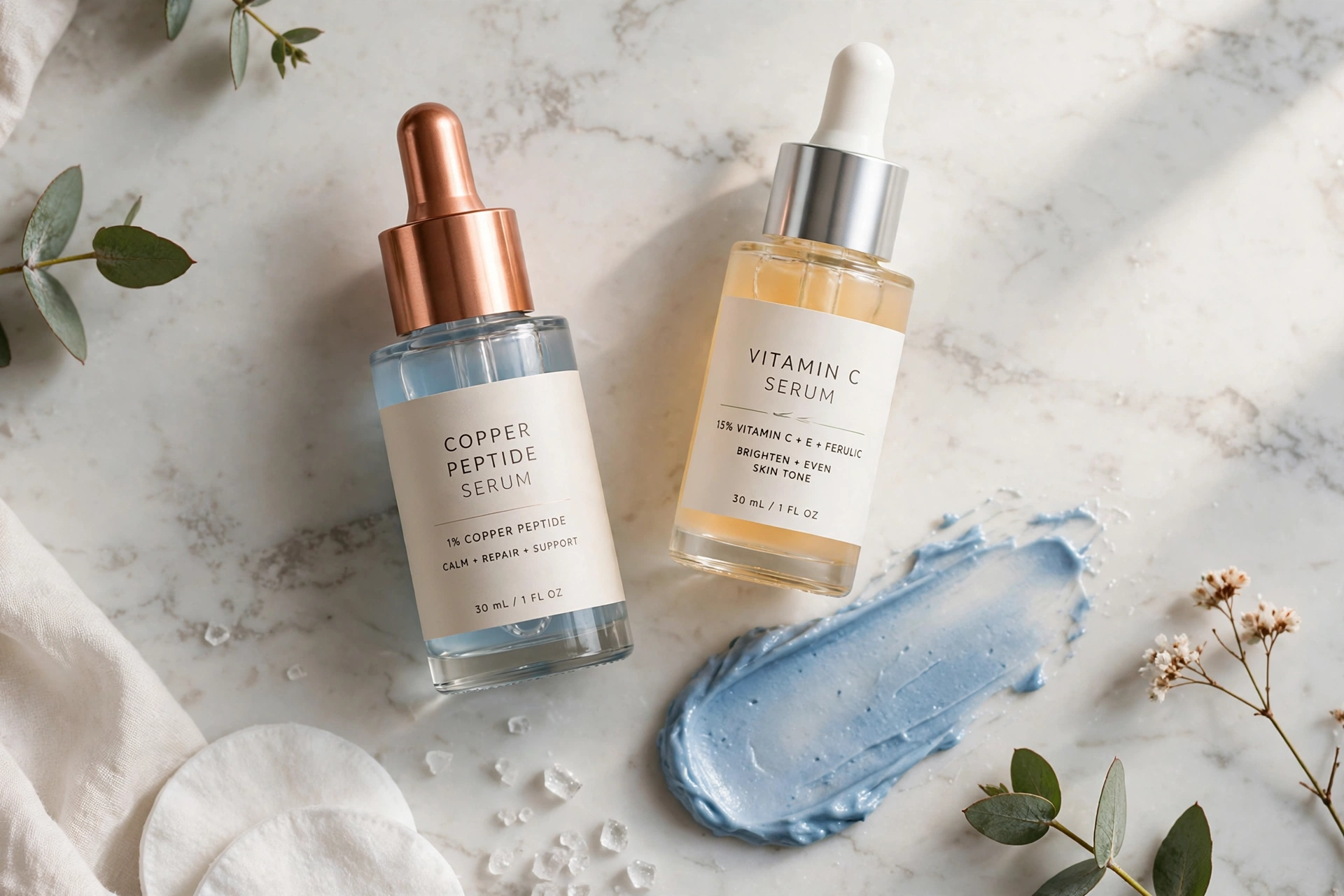
Can You Use Copper Peptides and Vitamin C Together UK? A Firming Guide
Can copper peptides and vitamin C be layered safely? A UK firming guide on order, routines, and who should skip the mix.
Read More arrow_forwardCan you use peptides and vitamin C together UK? Yes, with the right order and formulas. This guide explains safe layering, routines and sensitive-skin cautions.

If you have ever stood in front of your bathroom shelf wondering can you use peptides and vitamin c together uk routines safely, you are not alone. Peptides and vitamin C are two of the most talked-about skincare ingredients in Britain right now, and both promise firmer, brighter, healthier-looking skin. The good news is that, for most people, the answer is yes — but the way you combine them matters. Using the wrong order, mixing incompatible formulas, or layering too many strong actives at once can leave your skin irritated, red, or simply unimproved. This guide explains, in plain language, how peptides and vitamin C work, whether they can be used together, the safest order of application, morning and evening routines that actually work in UK weather, and who should be cautious. It is general information only, not medical advice, and if you have a diagnosed skin condition, persistent irritation, or you are using prescription treatments, speak to your GP or a dermatologist before changing your routine.
## Can You Use Peptides and Vitamin C Together UK? The Short Answer
Yes, most people can use peptides and vitamin C together, either in the same routine or split across morning and evening. Peptides are short chains of amino acids that signal the skin to support collagen and maintain its structure, while vitamin C is a well-studied antioxidant that brightens the skin, supports collagen production, and helps defend against environmental damage from pollution and sunlight. They do not cancel each other out in the way some old skincare myths suggested. The confusion originally came from pure L-ascorbic acid, the strongest and most acidic form of vitamin C, which can be unstable and irritating at low pH. Some people worried that this acidity might break peptides down. In practice, modern formulas are far more stable, and many brands now sell combined peptide and vitamin C serums. The safest approach for beginners is still to keep things simple: use one strong active at a time, introduce products slowly, and watch how your skin responds over two to four weeks before adding anything else. If your skin is sensitive, reactive, or recovering from a damaged barrier, separating the two ingredients — vitamin C in the morning and peptides at night — is usually the gentlest and most effective option.
## What Peptides Actually Do for Your Skin
Peptides are fragments of proteins, and in skincare they act like messengers. The most common types you will see on UK shelves are signal peptides such as Matrixyl, copper peptides, and neuropeptides. Signal peptides encourage the skin to behave as though it needs to produce more collagen, which over time can improve firmness and the appearance of fine lines. Carrier peptides help deliver trace elements such as copper to the skin, while other peptides aim to relax the look of expression lines. Peptides are generally well tolerated, which is why they suit a wide range of skin types, including combination and mature skin. They do not exfoliate, they do not increase sun sensitivity in the way retinoids do, and they work best with consistent, long-term use rather than overnight miracles. Most peptide serums feel lightweight and layer easily under moisturiser, making them a practical addition to both simple and more advanced routines. Results, when they come, tend to be gradual — think smoother texture and slightly firmer-looking skin after eight to twelve weeks of regular use, not a dramatic change in a week.
### How to Choose a Good Peptide Serum in the UK
Look for a serum that names its peptides clearly on the packaging, for example Matrixyl 3000, Argireline, or copper tripeptide-1, rather than a vague claim about a peptide blend. A water-based serum or light lotion texture usually layers best, especially if you also use vitamin C. Fragrance-free formulas are a safer choice for sensitive or reactive skin, and they are widely available at Boots, Superdrug, and Cult Beauty. Typical UK prices for a well-formulated peptide serum range from around £10 to £35 on the high street, with premium options higher, so you do not need to spend a fortune to get a good formula. Avoid buying peptides in a jar you dip your fingers into every day, because repeated exposure to air and bacteria can degrade the product faster. A pump bottle or dropper you handle carefully will keep the formula fresher for longer, and storing it away from direct sunlight and bathroom steam helps too.
## What Vitamin C Actually Does for Your Skin
Vitamin C, also known as ascorbic acid, is one of the most researched skincare antioxidants. It helps brighten dull skin, fade the look of dark marks left after spots, support collagen synthesis, and protect against free-radical damage from UV light and pollution. For UK skin, which faces grey winters, central heating, and sudden changes between cold outdoor air and warm indoor air, that antioxidant protection is genuinely useful all year round. Vitamin C comes in several forms. Pure L-ascorbic acid is the most potent but also the most likely to irritate, especially above 15 to 20 percent concentration. Gentler derivatives such as ethyl ascorbic acid, ascorbyl glucoside, and sodium ascorbyl phosphate are more stable, less acidic, and often a better starting point for sensitive or combination skin. A concentration between 10 and 15 percent is plenty for most people, and higher is not automatically better. If a vitamin C serum turns dark orange or brown, it has likely oxidised and lost much of its potency, so replace it rather than persevering with a stale product.
### Why Vitamin C Suits a Morning Routine
Vitamin C is most useful in the morning because it works alongside your sunscreen. Sunscreen blocks UV rays, while vitamin C helps neutralise some of the free-radical damage that still gets through, so the two together offer stronger daytime protection than either alone. This does not mean vitamin C replaces sunscreen — it never does, and daily SPF remains essential in the UK even on cloudy days, because UV radiation passes through cloud. Apply vitamin C after cleansing and toning, before moisturiser and sunscreen, and give it a minute to absorb. If you use a strong L-ascorbic acid formula, you may notice a slight tingling on application. Mild, brief tingling can be normal, but stinging, lasting redness, or flaking is a sign to switch to a gentler derivative, use it less often, or pause and let your skin recover.
## Can You Use Peptides and Vitamin C Together UK in the Same Routine?
The honest answer is that it depends on the formulas, not just the ingredients. A gentle vitamin C derivative layered under a peptide serum is usually fine in the same routine, and many people do this every morning without problems. A strong, low-pH L-ascorbic acid serum layered immediately under a copper peptide serum is the combination most likely to cause irritation or reduce effectiveness, because copper peptides and highly acidic vitamin C do not always sit happily together. If you are unsure, the simplest safe method is to split them: vitamin C in the morning for antioxidant protection, peptides in the evening to support overnight repair. This avoids any formula clash entirely, lets each ingredient work at its best, and makes it much easier to tell which product is causing a problem if irritation appears. If you prefer to use both in the morning, apply the thinnest product first, wait sixty to ninety seconds between layers, and finish with moisturiser and SPF. Never mix two serums together in your palm unless the brand specifically says the product is designed that way, because you cannot control the resulting pH or concentration.
## How to Use Peptides and Vitamin C Together UK: Order of Application
Getting the order right makes layering far more comfortable and effective. As a general rule, apply products from thinnest to thickest, and give each layer a short pause to absorb. For a morning routine, the order is: gentle cleanser, vitamin C serum, peptide serum if your skin tolerates both together, moisturiser, then sunscreen as the final step. For an evening routine, the order is: cleanser, any treatment serum, peptide serum, then a richer moisturiser or night cream. If you split the ingredients across the day, the order becomes even simpler: vitamin C plus moisturiser plus SPF in the morning, and peptides plus moisturiser at night. People with combination skin often find this split approach works best, because the morning can stay light while the evening can be more nourishing. If you also use other actives such as retinol or exfoliating acids, do not add them all on the same night. Rotate them across the week instead, and keep at least one or two nights per week completely simple — cleanser, moisturiser, and nothing else — so your skin barrier has time to recover. For a broader look at how other popular pairings behave, our [ingredient combinations guide](https://www.glowmagzine.com/blog/skincare-ingredient-combinations-guide-uk/) explains which actives layer well and which are better kept apart.
## Morning and Evening Routines That Work in UK Weather
UK weather asks a lot of your skin. Cold wind, rain, and central heating in winter can strip moisture, while summer brings stronger UV and humidity that can make combination skin oilier in the T-zone. A routine that works in January may feel too heavy in July, so adjust textures rather than swapping your active ingredients constantly. In winter, pair your vitamin C with a slightly richer moisturiser and do not skip SPF, because UV is present even when the sky is grey. In summer, choose lighter gel or lotion textures and make sure your sunscreen suits your skin type so it does not pill over your serums. A practical morning routine looks like this: rinse or cleanse gently, apply vitamin C, apply a light peptide serum only if your skin tolerates the combination, follow with a moisturiser suited to your skin type, and finish with a broad-spectrum SPF 30 or higher. A practical evening routine looks like this: cleanse thoroughly, especially if you wore sunscreen or makeup, apply your peptide serum to slightly damp skin if the formula allows, and seal it in with a moisturiser. Twice a week, you might add a gentle exfoliant or a retinoid on a different night, but never stack every active you own into a single routine in the hope of faster results. Patience and consistency beat intensity almost every time.
## Peptides vs Vitamin C vs Using Both: Comparison Table
| Feature | Peptides alone | Vitamin C alone | Peptides + vitamin C together |
|---|---|---|---|
| Main benefit | Firmness and smoother texture | Brightness and antioxidant protection | Firmness plus brightness together |
| Best time of day | Morning or evening | Morning, under sunscreen | Split: vitamin C AM, peptides PM |
| Irritation risk | Low for most people | Moderate with strong L-ascorbic acid | Low if split; higher if strong formulas layered |
| Results timeline | 8 to 12 weeks | 4 to 8 weeks for brightness | 8 to 12 weeks for combined benefits |
| Best for | Fine lines, loss of firmness | Dullness, dark marks, uneven tone | Ageing concerns plus dullness together |
| UK price range (typical) | Around £10 to £35 | Around £10 to £40 | Combined routine around £20 to £70 |
| Sun sensitivity | No increase | No increase, but always wear SPF | No increase, but always wear SPF |
The table shows why the combination appeals to so many people: peptides and vitamin C target different concerns, so together they cover more ground than either alone. The trade-off is simply that a combined routine needs a little more care with ordering and formula choice, especially if your skin is sensitive. If you are new to either ingredient, start with one for a month, then add the second. That way, if your skin reacts, you will know exactly which product to blame, and you will not waste money replacing a whole routine when only one product was the problem.
## Who Should Avoid Combining Peptides and Vitamin C?
Most people can combine these ingredients safely, but some should be cautious or seek advice first. If your skin barrier is currently damaged — signs include stinging when you apply plain moisturiser, persistent redness, flaking, or tightness — pause all strong actives and focus on barrier repair first. Our guide on [how to repair a damaged skin barrier](https://www.glowmagzine.com/blog/how-to-repair-damaged-skin-barrier-uk/) explains the gentle steps that help skin recover before you reintroduce actives. If you have rosacea, eczema, or perioral dermatitis, strong vitamin C in particular can trigger flare-ups, so a gentle derivative, patch testing, and advice from a dermatologist are sensible precautions. If you are pregnant or breastfeeding, most peptide and vitamin C products are generally considered low risk, but formulations vary, so check with your GP, pharmacist, or dermatologist if you are unsure about a specific product. If you use prescription treatments such as topical steroids, tretinoin, or acne medication, ask the prescribing clinician before adding new actives, because interactions and irritation risks depend on your exact treatment. Finally, if you have a known allergy to any ingredient in a formula, do not use that product, even if the headline ingredients sound gentle.
## Practical Tips for Layering Without Irritation
Patch testing is the single most useful habit in skincare, and it takes very little effort. Apply a small amount of a new product to your jawline or behind your ear once a day for three to five days before using it on your full face. Introduce only one new active at a time, and wait at least two weeks before adding another, so you can judge each product fairly. Use a pea-sized amount of serum for the whole face — more product does not mean faster results, and excess layers are more likely to pill or irritate. Wait between layers rather than rushing, keep your routine consistent for at least eight weeks before deciding a product is not working, and take a dated photo in the same light once a month if you want an honest record of change. Store vitamin C away from heat and light, close caps tightly, and discard serums that have changed colour dramatically or developed an unusual smell. If irritation appears, simplify immediately: stop the newest active, return to a gentle cleanser and moisturiser, and reintroduce products one at a time once your skin feels calm again. For context on how other vitamin C pairings behave, see our guide to [niacinamide and vitamin C together](https://www.glowmagzine.com/blog/niacinamide-and-vitamin-c-together-uk/) and our guide to [retinol and vitamin C together](https://www.glowmagzine.com/blog/can-you-use-retinol-and-vitamin-c-together-uk/), which cover similar layering questions in more detail.
## Buying Peptides and Vitamin C in the UK
You do not need imported or luxury products to build an effective routine. Boots and Superdrug stock reliable, affordable peptide and vitamin C options from brands such as The Ordinary, CeraVe, La Roche-Posay, and their own ranges, with typical prices from around £8 to £35 per product. Cult Beauty offers a wider range of premium and K-beauty options, usually from around £20 upwards, and is useful if you want a specific derivative or a fragrance-free formula that high-street stores do not carry. When shopping, check the full ingredient list rather than the front of the bottle, look for a stated vitamin C form and percentage, and be wary of products that promise instant wrinkle removal or permanent results — no over-the-counter skincare can deliver those claims. In the UK, sunscreens are regulated as cosmetics with specific testing standards, so choose a broad-spectrum product labelled SPF 30 or higher and reapply if you spend extended time outdoors. Buying from authorised UK retailers also reduces the risk of counterfeit or expired products, which is a real concern with heavily discounted imports from unknown sellers. For general, trustworthy background on skin health, the [NHS](https://www.nhs.uk/) and the [British Association of Dermatologists](https://www.bad.org.uk/) publish reliable patient information, and [DermNet](https://dermnetnz.org/) offers detailed dermatologist-reviewed explanations of ingredients and skin conditions.
## Frequently Asked Questions
### Can you use peptides and vitamin C together every day?
Yes, most people can use them daily once their skin has adjusted, especially when the ingredients are split between morning and evening. Start with alternate days for the first two weeks, then move to daily use if your skin stays calm. If you notice redness, stinging, or breakouts, drop back to alternate days or pause one ingredient until your skin settles.
### Should peptides or vitamin C go on first?
Apply the thinnest serum first, which is usually vitamin C in the morning. If you use both in the same routine, apply vitamin C, wait sixty to ninety seconds, then apply your peptide serum, followed by moisturiser. If you split them across the day, the question disappears entirely — vitamin C in the morning and peptides at night.
### Can you mix peptides and copper peptides with strong vitamin C?
This is the one pairing to treat with extra care. Copper peptides and strong, acidic L-ascorbic acid can interact and may cause irritation or reduce effectiveness. If you use a copper peptide product, either choose a gentle vitamin C derivative or use the two ingredients at different times of day. Standard signal peptides such as Matrixyl are generally easier to combine than copper peptides.
### Is it safe to use peptides and vitamin C if you have sensitive skin?
Often yes, but choose gentle formulas and introduce them slowly. A vitamin C derivative such as ascorbyl glucoside or sodium ascorbyl phosphate is usually better tolerated than pure L-ascorbic acid, and a fragrance-free peptide serum is a safer starting point. Patch test first, use each product on alternate days to begin with, and stop if you develop lasting redness or stinging.
### Can you use peptides, vitamin C, and retinol all together?
You can use all three across a week, but stacking them all in one routine is rarely a good idea, especially for beginners. A sensible weekly pattern is vitamin C in the morning, peptides most evenings, and retinol two or three evenings per week on nights when you skip other strong actives. Keep at least one simple night per week with just cleanser and moisturiser.
### Do peptides and vitamin C help with dark spots and fine lines?
Vitamin C is particularly helpful for brightness and the appearance of dark marks, while peptides are more focused on firmness and fine lines, so together they address both concerns. Neither ingredient erases deep wrinkles or pigmentation completely, and daily sunscreen is essential to protect any brightening progress. Expect gradual improvement over eight to twelve weeks, not overnight transformation.
### What should you do if peptides and vitamin C irritate your skin?
Stop the most recently introduced product first and simplify to a gentle cleanser and moisturiser until your skin feels calm, which usually takes a few days to a week. Then reintroduce one product at a time, on alternate days, to identify the trigger. If irritation persists, spreads, or involves swelling, blistering, or a rash, seek advice from your GP or a dermatologist rather than trying more products.
## Key Takeaways
- Peptides and vitamin C can be used together by most people, and they target different concerns: firmness and brightness.
- The safest method for beginners is to split them: vitamin C in the morning under sunscreen, peptides in the evening.
- Strong L-ascorbic acid and copper peptides are the pairing most likely to cause problems, so keep those apart.
- Start slowly, patch test, use one new active at a time, and allow eight to twelve weeks to judge results.
- Daily SPF remains essential, and a damaged or reactive skin barrier should be repaired before adding strong actives.
## Conclusion
So, can you use peptides and vitamin C together in a UK routine? For most people, the answer is a confident yes, provided you respect the basics: choose stable, well-formulated products, layer thinnest first, split strong formulas across morning and evening when in doubt, and never sacrifice your skin barrier for speed. Peptides bring steady support for firmness and texture, vitamin C brings brightness and antioxidant defence, and together they make a balanced, practical pairing for dullness, early fine lines, and uneven tone. Start with one ingredient if you are new to actives, add the second slowly, shop from trusted UK retailers, and give the routine time to work. If your skin is sensitive, reactive, or under medical treatment, a quick check with your GP or dermatologist will help you personalise this general guidance safely. With a simple, consistent routine, this is one ingredient combination that genuinely earns its place on the shelf.
Can copper peptides and vitamin C be layered safely? A UK firming guide on order, routines, and who should skip the mix.
Read More arrow_forward
A gentle UK guide to pairing bakuchiol with vitamin C: layering order, AM/PM routines, who should avoid it, and how to get glow without irritation.
Read More arrow_forward
A calm-skin UK guide to pairing panthenol with retinol: layering order, AM/PM routines, who should avoid it, and how to keep irritation low.
Read More arrow_forward
Discover how urea and salicylic acid work together for smoother, softer skin, plus UK layering tips, strengths, and routines for dry or bumpy skin.
Read More arrow_forward
Can you use bakuchiol and retinol together UK? Yes — this gentle pairing guide explains layering order, routines and who should avoid it.
Read More arrow_forwardCalculate your Body Mass Index (BMI) in seconds. BMI is a quick screening number…
Use now arrow_forwardFind your daily calorie needs based on your age, sex, height, weight and activit…
Use now arrow_forwardFind how much water you should drink each day, in litres and glasses, based on y…
Use now arrow_forward