Can You Use Azelaic Acid and Vitamin C Together? UK Layering Guide (2026)
Yes, azelaic acid and vitamin C work great together. UK guide to layering order, AM/PM routines, the best £ products and who should skip this duo.
Read More arrow_forwardGlycolic acid vs lactic acid — which AHA is right for your skin? Our UK guide compares strength, skin types, best percentages and top UK products.
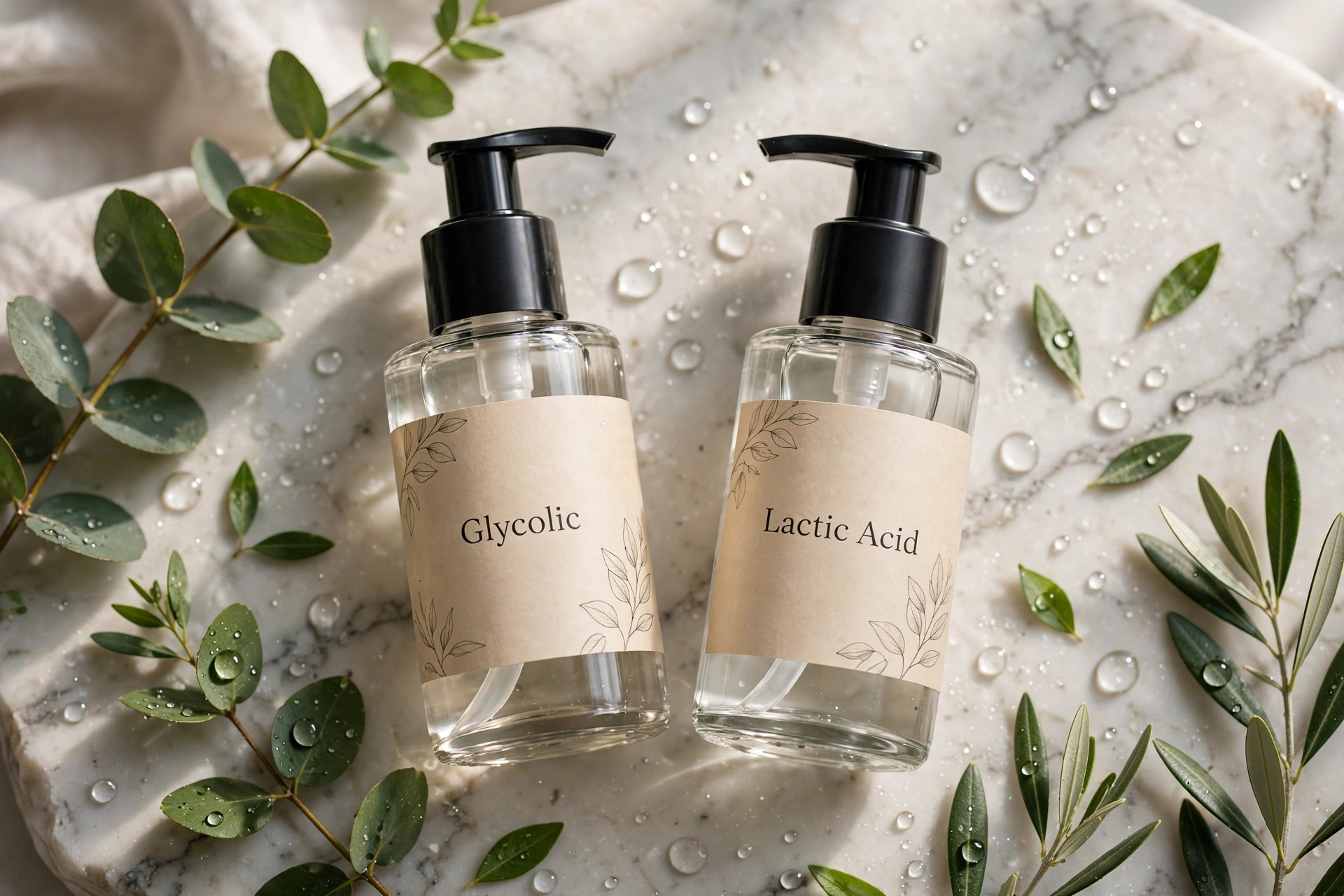
Walk down the skincare aisle at Boots or scroll through Superdrug's website and you'll notice two ingredients that appear on bottle after bottle: glycolic acid and lactic acid. They're both alpha-hydroxy acids (AHAs) — the celebrated family of chemical exfoliants that dissolve the bonds between dead skin cells to reveal smoother, brighter, more even skin underneath. But while they belong to the same family, they are not interchangeable, and choosing the wrong one for your skin type can mean the difference between a radiant glow and a red, irritated face.
So: glycolic acid vs lactic acid — which should you actually buy? The honest answer is that it depends on your skin type, your tolerance, your concerns and, crucially, how patient you're willing to be. Glycolic acid is the heavyweight: the smallest AHA molecule, the deepest penetrator, the most potent exfoliant of the two. Lactic acid is its gentler sibling: a larger molecule that works more slowly, hydrates while it exfoliates, and plays far better with sensitive, dry or reactive skin.
In this guide we'll break down exactly how these two AHAs differ — their chemistry, their strengths, who they're best for, what percentages to look for, and how to introduce each one safely into your routine. We'll also give you a side-by-side comparison table, a clear verdict for every skin type, and our top UK product picks with real £ prices and where to buy them at Boots, Superdrug and Cult Beauty.
Before we pit these two ingredients against each other, a quick refresher. Alpha-hydroxy acids are water-soluble acids derived mostly from plant and milk sources. They work by breaking the desmosome bonds — the tiny "glue" holding dead skin cells to the surface of your skin — so those cells shed faster and more evenly. Regular, well-managed AHA use can visibly improve dullness, uneven texture, fine lines, hyperpigmentation, clogged pores and dryness-related roughness.
AHAs are different from BHAs like salicylic acid, which are oil-soluble and penetrate into pores to clear out sebum. AHAs work primarily on the surface of the skin, which makes them brilliant for texture, tone and glow — but also means they need one non-negotiable partner: daily sunscreen. AHAs increase your skin's sun sensitivity, and in the UK this matters more than people think, because UVA damage continues through cloud cover all year round. If you're using any AHA, a broad-spectrum SPF is mandatory every morning — our guide to the best sunscreens for 2026 breaks down which formulas pair best with active ingredients.
Glycolic acid is derived from sugar cane and has the smallest molecular size of any AHA. That tiny size is both its superpower and its catch: it penetrates deeper and faster into the skin than lactic acid, which is why it's the most effective AHA for visible resurfacing — but also why it's the most likely to cause stinging, redness and irritation, especially at higher percentages.
Because it gets to work quickly, glycolic acid is the go-to AHA for:
Uneven texture and dullness — it visibly resurfaces rough skin within days to weeks
Fine lines and early ageing — clinical evidence supports its role in stimulating collagen production at moderate-to-high concentrations
Hyperpigmentation and dark marks — speeds up the fading of post-inflammatory marks and sun spots by accelerating cell turnover
Congested, breakout-prone skin — helps unclog pores and smooths bumpiness (though salicylic acid is usually better for deep pore congestion)
Oily and resilient skin types — can handle its potency comfortably
Glycolic acid products on the UK high street range from gentle daily formulas to serious treatment products:
5–8%: suitable for beginners and daily or every-other-day use
10–15%: moderate strength — effective weekly treatments or regular toners for tolerant skin
20–30%: strong treatments (pads, peels) — use weekly at most, and only once your skin is accustomed
50–70%: professional/clinic peels only — never attempt at home
Choose glycolic if you have oily, combination or resilient skin, if your main concerns are texture, dullness, fine lines or stubborn dark marks, and if your skin has already tolerated acids before. If you've previously used niacinamide or other actives without drama and you're looking for the most visible results per application, glycolic is your acid.
Lactic acid is derived from milk (or fermented plant sources in modern formulas) and has a significantly larger molecule than glycolic acid. It penetrates more slowly and stays closer to the skin's surface — which means gentler exfoliation with far less stinging. But lactic acid has a second trick up its sleeve: it's a humectant, meaning it draws moisture into the skin. So unlike most exfoliants, it hydrates while it exfoliates, leaving skin softer rather than stripped.
Lactic acid is the better choice when:
Your skin is dry, dehydrated or sensitive — the hydrating effect makes it far more comfortable
You're an AHA beginner — it's the safest entry point into chemical exfoliation
You have mild hyperpigmentation — effective for fading dark marks, just more gradually than glycolic
Your skin barrier feels fragile — lactic acid is much less likely to disrupt it
You have rosacea-prone or reactive skin — often tolerated where glycolic is not (though always patch test)
5–10%: daily or every-other-day use for sensitive and beginner skin
10–15%: effective regular use for most skin types once tolerance is established
20%+: treatment-strength — approach with caution and use infrequently
Choose lactic if you have dry, sensitive, reactive or first-time-exfoliant skin, if your barrier has ever felt compromised, or if your priority is gentle, consistent improvement rather than dramatic overnight results. If you've ever over-exfoliated and had to spend weeks repairing your skin barrier, lactic acid is the forgiving option.
Here's the side-by-side breakdown so you can see exactly where each AHA wins:
Feature | Glycolic Acid | Lactic Acid
Source | Sugar cane | Milk / fermented plants
Molecular size | Smallest AHA — penetrates deepest | Larger molecule — works at the surface
Exfoliation strength | Strong | Mild to moderate
Speed of results | Fast — visible in days/weeks | Gradual — visible in weeks
Hydration | Minimal | Yes — natural humectant
Irritation risk | Moderate to high | Low to moderate
Best for skin types | Oily, combination, resilient, mature | Dry, sensitive, reactive, beginner
Best for concerns | Texture, dullness, fine lines, stubborn pigmentation | Dryness, mild pigmentation, sensitivity, maintenance
Typical % range | 5–30% (at-home) | 5–15% (at-home)
Beginners | Introduce slowly | Safest starting point
Sun sensitivity | Increases — SPF essential | Increases — SPF essential
The bottom line: neither acid is universally "better." Glycolic acid is the stronger exfoliant; lactic acid is the kinder one. Most skincare lovers eventually try both and settle on the one that matches their skin's temperament — or use glycolic in winter when skin is tougher and lactic in summer when skin is more reactive.
A common question: can you mix glycolic and lactic acid? The short answer is that you should not layer them on top of each other in the same routine — that doubles the exfoliation load and dramatically raises your irritation risk. But you can absolutely rotate them:
Rotation method: use one AHA 2–3 evenings per week, and the other on a different evening. For example, glycolic on Mondays and Thursdays, lactic on Sundays.
Seasonal rotation: glycolic in autumn/winter when UV is lower and skin is hardier; lactic in spring/summer when sensitivity is higher.
Zone method: some people use glycolic on the T-zone (oily, congested) and lactic on the cheeks (drier, more sensitive) — though this requires confidence in your skin's responses.
Never use either AHA on the same night as retinoids, benzoyl peroxide or vitamin C unless your skin is very well acclimatised and you're using them at different times of day (vitamin C in the morning, AHA at night). And if you notice persistent redness, stinging that doesn't fade in minutes, or flaking — stop, simplify your routine, and focus on barrier repair before reintroducing any acid.
Whichever acid you choose, the introduction matters more than the percentage. Skincare enthusiasts who rush this step end up with raw skin and a drawer full of abandoned bottles. Here's a safe ramp-up plan:
Apply a small amount behind your ear or on your jawline. Wait 24 hours. If there's no prolonged redness, itching or swelling, proceed. (Slight tingling on application is normal with AHAs; persistent burning is not.)
Use your chosen AHA one evening per week, on clean, dry skin. Follow with a simple, fragrance-free moisturiser. No other actives that night. Proper double cleansing beforehand ensures the acid contacts clean skin and works evenly.
If your skin is calm, increase to two non-consecutive evenings per week. Keep the rest of your routine simple and supportive — hyaluronic acid serums and ceramide moisturisers are ideal companions.
Most people settle at 2–3 times per week for glycolic and up to every other night for lactic. More is not better — exfoliation is a dose-dependent process, and overdoing it causes the exact problems (dullness, breakouts, sensitivity) you bought the acid to fix. Daily SPF every morning remains non-negotiable throughout.
These are tried-and-tested options available right now at UK retailers, covering every budget:
The Ordinary Glycolic Acid 7% Exfoliating Toner — ~£10 (Boots, Superdrug, Cult Beauty) The cult classic and arguably the best-value AHA in the UK. 7% glycolic with amino acids, aloe vera and ginseng to buffer irritation. Perfect beginner-to-intermediate glycolic — use 2–3 evenings a week. A 240ml bottle lasts months.
Pixi Glow Tonic — ~£20 (Boots, Cult Beauty) 5% glycolic with aloe vera and ginseng. Gentler than The Ordinary's formula, this is the ideal "training wheels" glycolic for first-timers. Lovely daily-or-alternate-day toner.
Alpha-H Liquid Gold — ~£46 (Cult Beauty, Lookfantastic) An Australian icon with 5% glycolic at a low pH, making it act stronger than its percentage suggests. Famous for overnight glow. Start with 2–3 nights a week.
Nip+Fab Glycolic Fix Daily Cleansing Pads — ~£9 (Boots, Superdrug) Budget-friendly exfoliating pads — great for travel or for people who prefer a wipe-off format. Gentle enough for most skin types.
The Inkey List Glycolic Acid Exfoliant — ~£11 (Boots, Superdrug, Cult Beauty) 10% glycolic serum for those ready to step up from toner strengths. Excellent value and widely available.
The Ordinary Lactic Acid 10% + HA — ~£8 (Boots, Superdrug, Cult Beauty) The undisputed budget champion. 10% lactic acid with hyaluronic acid for hydration. There's also a 5% version (~£8) if your skin is very sensitive — start there.
Sunday Riley Good Genes Lactic Acid Treatment — ~£85 (Cult Beauty, Space NK) The luxury benchmark. Lactic acid with liquorice and lemongrass for brightening and a famous instant radiance effect. A splurge, but a little goes a long way.
CeraVe SA Smoothing Cleanser — note: this is a BHA; for a gentle lactic option try… Actually, for high-street lactic acid cleansers, look at Boots' own-brand lactic acid ranges and Superdrug's Naturally Radiant Glycolic range (~£5–£8) — both routinely discounted and ideal for testing whether your skin likes AHAs before investing.
Paula's Choice Skin Perfecting 8% AHA Gel Exfoliant — ~£35 (Cult Beauty) Technically a glycolic blend, but its gel format and pH make it behave closer to a gentle lactic experience. A great "best of both worlds" pick for combination skin.
Sunscreen is the price of admission. Both acids increase photosensitivity. The NHS advises protecting skin from sun damage as part of managing skin conditions, and the British Association of Dermatologists similarly emphasises sun protection when using treatments that thin or sensitise the skin. Apply a broad-spectrum SPF 30+ every morning — no exceptions.
Apply to dry skin. Wet skin increases penetration and therefore irritation. Wait a few minutes after cleansing before applying your AHA.
Sandwich sensitive skin. If you're nervous, apply a light moisturiser first, then the acid, then moisturiser again. This "buffering" slows absorption and cuts stinging dramatically.
Don't mix acids and retinoids on the same night until you're experienced. Alternate evenings instead.
Give it 4–6 weeks. Cell turnover takes about 28 days, so judge results after a full cycle, not after three applications.
Less is more with frequency. Two to three times weekly beats daily for most people. Research published via PubMed consistently shows that controlled, moderate AHA use delivers the benefits while limiting irritation.
Lactic acid, without question. Its larger molecule, slower penetration and built-in hydration make it the most forgiving AHA. Start with 5–10% lactic acid once or twice a week, and only consider glycolic once your skin is comfortable with regular exfoliation.
Glycolic acid works faster on pigmentation because it penetrates deeper and accelerates cell turnover more aggressively. That said, lactic acid also fades dark marks — just more gradually. If your marks are stubborn, glycolic at 10–15% used consistently will show results sooner. Always pair either with daily SPF, or the marks will simply return.
Most people shouldn't. Daily glycolic use at meaningful percentages risks over-exfoliation — thinning the barrier, causing sensitivity, breakouts and dullness. Two to three times per week is the sweet spot for most skin types. Lactic acid at 5–10% is better tolerated for near-daily use, but even then, listen to your skin.
It's the AHA most likely to be tolerated by sensitive skin, and many people with mild rosacea use low-strength lactic acid successfully. However, "sensitive-friendly" doesn't mean risk-free — always patch test, start at 5%, and stop if you experience persistent redness. For dedicated guidance, read our guide to azelaic acid for rosacea, which is often the better first active for reactive skin.
Yes, always. AHAs remove dead cells but can temporarily compromise your moisture barrier. Follow every AHA application with a hydrating, fragrance-free moisturiser — ideally one with ceramides or hyaluronic acid — to seal in moisture and support recovery.
Yes, but not layered together. Use vitamin C in the morning and your AHA in the evening — this is the classic dermatologist-recommended split. Layering them simultaneously can drop the pH too low and cause irritation. Our guide to the best vitamin C serums covers morning-friendly formulas that pair well with an evening AHA.
Glycolic acid, generally — its deeper penetration tackles the congestion and texture that oily skin struggles with. However, if your breakouts are deep and pore-based, a BHA like salicylic acid may serve you better than any AHA. Many oily-skinned people rotate: salicylic acid for pores, glycolic for surface texture.
This is a persistent myth. Properly used AHAs actually thicken the dermis over time by stimulating collagen production — they only thin the outermost dead-cell layer (the stratum corneum), which is the entire point. Problems arise only from overuse. Stick to sensible frequencies and percentages and your skin will be stronger, not weaker.
Glycolic acid = the stronger, faster AHA — best for oily, resilient skin and concerns like texture, dullness, fine lines and stubborn pigmentation.
Lactic acid = the gentler, hydrating AHA — best for dry, sensitive, reactive or beginner skin, and for comfortable long-term maintenance.
Start low, go slow: patch test, then 1–2 evenings per week, building to 2–3 times weekly.
Never layer the two acids together; rotate them on different nights or different seasons instead.
Daily SPF 30+ is mandatory with any AHA, year-round in the UK.
Budget picks: The Ordinary Glycolic 7% Toner (~£10) and The Ordinary Lactic Acid 10% + HA (~£8) — both at Boots, Superdrug and Cult Beauty.
If your skin is oily, tough and impatient for results — go glycolic. If your skin is dry, sensitive, new to acids or easily offended — go lactic. And if you're somewhere in between, start with lactic, build your tolerance over a month or two, then experiment with glycolic on the nights your skin feels robust.
The glycolic acid vs lactic acid debate doesn't have a single winner because the two acids are answering different questions: maximum power versus maximum kindness. Whichever you choose, the rules are the same — patch test, introduce slowly, moisturise after, and never skip sunscreen. Follow them, and either AHA will earn its place as the hardest-working step in your routine.
Yes, azelaic acid and vitamin C work great together. UK guide to layering order, AM/PM routines, the best £ products and who should skip this duo.
Read More arrow_forward
Tranexamic acid fades melasma and dark spots by blocking pigment signals. How it works, which % to use, layering rules and the best UK products.
Read More arrow_forwardCalculate your Body Mass Index (BMI) in seconds. BMI is a quick screening number…
Use now arrow_forwardFind your daily calorie needs based on your age, sex, height, weight and activit…
Use now arrow_forwardFind how much water you should drink each day, in litres and glasses, based on y…
Use now arrow_forward