How to Get Rid of Sebaceous Filaments UK: A Smooth-Skin Guide
Learn how to get rid of sebaceous filaments UK gently, with salicylic acid, retinoids and a realistic routine — no squeezing or pore-strip damage.
Read More arrow_forwardWinter skincare for sensitive skin UK: routines, barrier repair and rosacea tips for cold weather, with UK product picks from Boots, Superdrug and Cult Beauty.
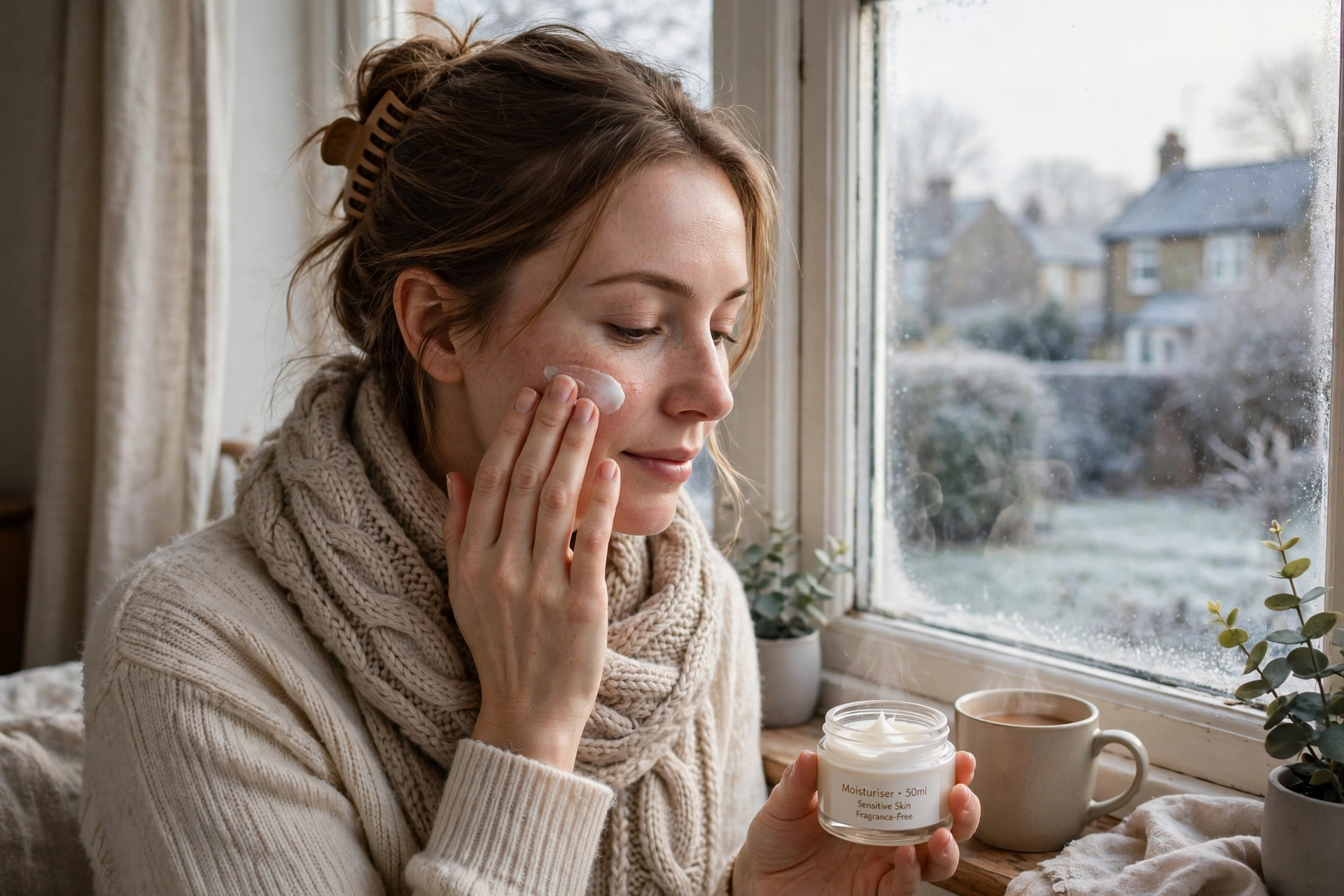
If your skin turns red, tight, flaky or reactive every time the temperature drops, then winter skincare for sensitive skin uk routines are worth learning properly, because the cold months ask far more of your skin than summer ever does. Sensitive and rosacea-prone skin already has a weaker barrier than other skin types, which means it loses moisture faster, reacts more strongly to temperature changes and recovers more slowly from irritation. Add freezing wind, central heating, low humidity and hot showers, and it is no surprise that so many people in the UK dread the colder months. The good news is that winter skin problems are mostly predictable, and a few sensible changes to your routine can make a real difference.
This guide covers everything you need to get through a British winter with calm, comfortable skin. You will learn why cold weather makes sensitive skin worse, how to build a simple morning and evening routine, which ingredients help and which ones to avoid until spring, how to layer products in the right order, how to repair a damaged barrier, why sunscreen still matters in December, and which products to buy at Boots, Superdrug and Cult Beauty without overspending. Every recommendation is practical, realistic for everyday life in the UK, and designed for skin that flares up easily. Whether you have rosacea, eczema-prone skin, or skin that simply stings and flushes whenever the weather changes, this guide will help you build a winter routine you can actually stick with.
Why Winter Worsens Sensitive and Rosacea-Prone Skin
How Cold Weather Triggers Rosacea and Sensitivity
Your Step-by-Step Winter Routine
The Morning Routine: AM Steps in Detail
The Evening Routine: PM Steps in Detail
Ingredients to Use in Cold Weather
Ingredients to Avoid in Winter
Layering Order: How to Apply Winter Skincare Products
Barrier Repair: Rebuilding Skin That Winter Has Damaged
Sunscreen in Winter: Why You Still Need SPF
Makeup Tips for Sensitive Skin in Winter
Indoor Heating, Humidity and Your Skin
When to See a GP or Dermatologist
UK Product Picks for Winter
Common Winter Skincare Mistakes to Avoid
Frequently Asked Questions
Winter in the UK is not just cold — it is a constant swing between extremes, and that swing is exactly what sensitive skin struggles with. You step out of a warm house into freezing wind, then into a heated shop, then back out into the cold again. Each change forces the tiny blood vessels in your skin to expand and contract, which is why cheeks flush, noses turn red and rosacea flares up so often between November and February. The air outside is cold and dry, while the air inside is warm and dry, so your skin loses moisture from both sides at once. A routine that worked perfectly in July can suddenly leave your skin tight, flaky and stinging by December, and that is not a sign that your products have stopped working — it is a sign that the season has changed and your routine needs to change with it.
The first thing to understand is that winter skincare is not about adding more and more products. It is about protecting the skin barrier, reducing irritation and keeping moisture in. Sensitive skin in winter needs gentler cleansing, richer moisturising and fewer strong active ingredients, at least until the weather warms up again. Many people make the mistake of trying to fix winter dryness with exfoliation, scrubbing away flakes in the hope of revealing smooth skin underneath. In reality, that usually makes things worse, because it strips away the very barrier that is trying to protect your skin. The right approach is almost the opposite: be kinder, use fewer actives, moisturise more generously and let your skin recover.
Another reason winter needs a different approach is that the UK winter brings very little daylight, which can make it tempting to skip sunscreen altogether. That is a mistake, as this guide explains later, because ultraviolet light is present all year round and can worsen redness and pigmentation even on cloudy days. Winter also tends to bring more indoor time, more hot baths and showers, and more central heating, all of which dry the skin further. A good winter routine therefore looks at your whole day, not just the products on your bathroom shelf. It includes how you wash your face, how hot your shower is, how humid your bedroom is and how you protect your skin before stepping outside.
If you take only one idea from this guide, let it be this: winter is the season to simplify and soothe. Choose fragrance-free products, use lukewarm water, moisturise while your skin is still slightly damp, and give your skin time to adjust before introducing anything new. Your skin will thank you for the patience, and by the time spring arrives, you will have a stronger barrier and calmer skin than you started the winter with.
To manage winter skin well, it helps to understand what cold weather actually does to your skin. The skin barrier is a layer of skin cells held together by lipids, a little like bricks held together by mortar. In healthy skin, this barrier keeps moisture in and irritants out. In sensitive and rosacea-prone skin, the barrier is often weaker, with gaps that let moisture escape and irritants slip through. Cold air and wind dry out the skin surface and make those gaps worse, while low humidity pulls even more water out of the skin. The result is the familiar winter pattern: tightness after washing, flaking around the nose and chin, stinging when you apply products that never used to sting, and redness that takes longer to fade.
Rosacea deserves special attention in winter because temperature change is one of its most common triggers. The blood vessels in rosacea-prone skin are more reactive than normal, so they dilate quickly in response to cold wind and then again when you come back into the warmth. That repeated flushing can leave skin red for hours and, over time, can make visible blood vessels more noticeable. Wind is a particular problem, because it strips away the thin layer of warm air that normally protects the skin surface, cooling the skin rapidly. A scarf pulled up over the lower face on windy days is one of the simplest and most effective rosacea tips there is, because it creates a physical barrier between your skin and the wind.
Central heating adds a second problem. Heated indoor air in UK homes is often very dry, and spending all day in it slowly dehydrates the skin, even if you never step outside. If you work in an office with strong heating, your skin may feel fine in the morning and tight and uncomfortable by the afternoon. Hot showers and baths make things worse still, because hot water strips the natural oils from the skin surface. A long hot bath on a cold evening feels wonderful, but for sensitive skin it can undo a whole day of careful moisturising. Lukewarm water, shorter showers and moisturiser applied straight afterwards are much kinder.
Stress and illness also play a part in winter flare-ups. The darker months, the pressure of the festive season and the usual round of winter colds can all raise stress levels, and stress is a known trigger for both rosacea and eczema. When you are unwell, your skin barrier often suffers too, because your body is busy fighting infection rather than maintaining your skin. None of this means winter flare-ups are your fault. It means that a good winter routine needs to be gentle enough to cope with bad weeks as well as good ones, and that you should not judge a new routine after only a few days. Give any change at least two to three weeks before deciding whether it is helping, and keep the rest of your routine steady while you test it.
The British Association of Dermatologists provides reliable information about rosacea and its triggers, and their guidance is a good place to start if you want to understand your own skin better. You can find it on the British Association of Dermatologists website, which explains the condition in plain language and outlines the treatment options available in the UK.
A good winter routine for sensitive skin does not need to be long or expensive. In fact, the shorter it is, the more likely you are to follow it every day, and consistency matters far more than having a shelf full of products. The routine below is built around five steps in the morning and five steps in the evening, and most people will find that it takes no more than five minutes at each end of the day. The key changes from a summer routine are a gentler cleanser, a richer moisturiser, a hydrating layer underneath your cream, and a much lighter touch with active ingredients. If your skin is very reactive, you can strip the routine back even further — cleanser, moisturiser and sunscreen in the morning, cleanser and moisturiser at night — and still get most of the benefit.
Start by looking at what you already own. Many people already have a perfectly good winter routine hiding in their bathroom cabinet, and they only need to change one or two products rather than buying everything new. Check your cleanser first: if it foams heavily or leaves your skin feeling squeaky clean, it is probably too harsh for winter and should be swapped for a cream or gel cleanser. Check your moisturiser next: if it is a light gel or lotion that disappears in seconds, you probably need something richer for the cold months. And check your actives: if you use retinol, strong vitamin C or exfoliating acids, consider reducing how often you use them, or pausing the strongest one until spring. These small adjustments often make more difference than any single new purchase.
It also helps to think of your winter routine as having two jobs. The first job is to protect: to shield your skin from cold, wind and dry indoor air, and to keep moisture locked in. The second job is to repair: to support the skin barrier so that it can recover from the daily stress of winter weather. Moisturiser does most of the protecting, while barrier-friendly ingredients such as ceramides, glycerin, squalane and hyaluronic acid do most of the repairing. You do not need all of them at once. A single well-chosen moisturiser that contains two or three of these ingredients is usually enough, especially if you apply it generously and consistently.
One final point before the step-by-step routines: introduce changes one at a time. If you change your cleanser, moisturiser and serum all in the same week and your skin flares up, you will have no idea which product caused it. Change one product, wait a week or two, and only then change the next. Patch test new products on a small area, such as behind your ear or along your jawline, for a few days before using them all over your face. This slow approach feels frustrating when you want fast results, but it is the quickest route to a routine that actually works, because it avoids the setbacks that come from guessing wrong.
Your morning routine has one main purpose: to prepare your skin for the day ahead and protect it from everything the British winter will throw at it. Keep it simple and do it in the same order every day, so it becomes a habit rather than a chore. The whole routine should take about five minutes.
Step one is cleansing, and in winter this step should be as gentle as possible. If your skin feels comfortable in the morning, you can simply rinse with lukewarm water and skip cleanser altogether — many dermatologists recommend this for very dry or reactive skin in winter, because it avoids stripping away the oils your skin produced overnight. If you prefer to cleanse, use a small amount of a fragrance-free cream or gel cleanser, massage it gently over damp skin and rinse with lukewarm water, never hot. Pat your face dry with a clean towel rather than rubbing, and leave your skin slightly damp for the next step. Choosing the right cleanser matters more in winter than at any other time of year, so if you are unsure where to start, our guide to the best fragrance-free face wash for rosacea-prone skin UK compares gentle options that are easy to find on the UK high street.
Step two is a hydrating layer. While your skin is still slightly damp, apply a hyaluronic acid serum or a hydrating essence, pressing it gently into your skin with your fingertips. Hyaluronic acid draws water into the upper layers of the skin, which helps to counteract the drying effect of cold air and central heating. In very dry indoor air, it works best when it is sealed in with a moisturiser straight afterwards, so do not leave a long gap between this step and the next. If hyaluronic acid makes your skin feel tight, which can happen in very low humidity, try applying it to damp skin and following immediately with your moisturiser, or swap it for a glycerin-based hydrating serum instead.
Step three is moisturiser, and in winter this is the most important step of all. Choose a richer cream than you use in summer, and apply a generous amount — more than you think you need — over your face and neck. Look for ceramides, glycerin, squalane or shea butter on the ingredient list, and choose fragrance-free formulas whenever possible. If your usual moisturiser feels too light by midday, you can either switch to a richer one for winter or add a few drops of a plain facial oil, such as squalane oil, on top. Do not forget your neck and the skin around your ears, which are often exposed to the wind and just as prone to dryness as your face.
Step four is sunscreen, even in the middle of winter. Apply a broad-spectrum sunscreen with at least SPF 30 as the last step of your morning routine, after your moisturiser has had a minute to sink in. In the UK, sunscreen is classed as a cosmetic, but the rules still require proper UVA protection, so look for the UVA star rating on the bottle alongside the SPF number. If your skin is sensitive, a mineral sunscreen with zinc oxide or titanium dioxide is often better tolerated than a chemical one, and it is less likely to sting on reactive skin. On very cold days, sunscreen also adds a useful extra layer of protection against wind, which is a welcome bonus.
Step five is protection before you leave the house. On windy or freezing days, pull a soft scarf up over your lower face, wear a hat that does not rub against your forehead, and consider a thin layer of a barrier balm or a richer cream on your cheeks and nose before you go out. If you wear makeup, let your sunscreen settle for a few minutes before applying it, and choose a hydrating foundation rather than a matte one in winter. These small habits take seconds, but they protect your skin during the hours when it is most exposed to the cold.
Your evening routine is the time to clean away the day and let your skin repair itself overnight. Skin does much of its healing while you sleep, so a calm, nourishing evening routine is one of the best investments you can make in winter. Keep it gentle, keep it consistent, and resist the urge to use strong treatments just because you have more time in the evening.
Step one is removing makeup and sunscreen. If you wore makeup or sunscreen during the day, start with a gentle first cleanse: a micellar water on a soft cotton pad, or a fragrance-free cleansing balm massaged over dry skin and rinsed away with lukewarm water. This step lifts away the day's products without scrubbing, which matters for sensitive skin. Follow with your usual gentle cleanser as a second step, using lukewarm water and patting your skin dry. If you did not wear makeup or sunscreen, a single gentle cleanse is enough — there is no need to double cleanse every night in winter, because over-cleansing strips the barrier you are trying to protect.
Step two is an optional treatment step, and in winter it is best kept minimal. If your skin is calm, you can use a gentle treatment product, such as a low-strength azelaic acid product or a hydrating serum, on two or three evenings a week. If your skin is flaring, skip this step entirely and focus on moisturising instead. There is no rule that says you must use an active ingredient every night, and in winter the bravest choice is often to leave your skin alone and let it recover. If you do use a treatment product, apply it to clean, dry skin and wait a minute before the next step.
Step three is a hydrating layer, just as in the morning. Apply your hyaluronic acid serum or hydrating essence to slightly damp skin, pressing it in gently. In the evening you can afford to be more generous, because there is no sunscreen or makeup to follow, and your skin has all night to absorb the moisture. If your skin feels very dry, you can layer a second thin coat of the hydrating serum, waiting a minute between coats.
Step four is a rich night moisturiser. Choose the richest moisturiser your skin tolerates, and apply it generously over your face and neck. In the depths of winter, many people with sensitive skin find that a thick cream or a balm-style moisturiser works better at night than the lighter cream they use in the morning. Look for ceramides and cholesterol on the ingredient list, because these lipids help to rebuild the skin barrier while you sleep. If your skin is extremely dry, you can finish with a thin layer of a plain occlusive balm, such as a fragrance-free petroleum-based ointment, over the driest areas — this seals in all the moisture underneath and is particularly helpful on wind-chapped cheeks and around the nose.
Step five is the rest of your body, which is easy to forget when you are focused on your face. Before bed, apply a rich body moisturiser to any areas that feel dry, especially your hands, shins and elbows, and consider wearing cotton gloves overnight if your hands are cracked and sore. Keep a hand cream by your bed and another by the kitchen sink, because hands are washed so often in winter that a single daily application is rarely enough. A calm evening routine, a warm bedroom that is not overheated, and a good night's sleep will do more for your skin than any expensive night cream on its own.
Winter is the season to lean on ingredients that hydrate, soothe and support the skin barrier. You do not need a long list — a handful of well-chosen ingredients, used consistently, will carry you through the cold months. The best winter ingredients are the ones that work quietly in the background, reducing water loss and calming irritation rather than forcing rapid change.
Ceramides are the first ingredient to look for in winter. They are lipids that occur naturally in the skin barrier, and they act like the mortar between the bricks of your skin cells, holding everything together. When your barrier is damaged by cold and wind, ceramides help to fill the gaps and reduce moisture loss. Many of the best winter moisturisers at Boots and Superdrug are built around ceramides, and they suit almost every skin type, including rosacea-prone skin. If you only change one thing in your routine this winter, switching to a ceramide-rich moisturiser is the change most likely to help.
Glycerin is another winter essential. It is a humectant, which means it attracts water into the skin, and it is one of the most reliable and well-tolerated hydrating ingredients available. Glycerin appears in a huge number of moisturisers and serums, often near the top of the ingredient list, and it works well even in very cold weather when it is sealed in with a cream or balm. Hyaluronic acid works in a similar way, drawing water into the upper layers of the skin, and it is a good choice for people who want hydration without a heavy feeling. Use it on damp skin and always follow with moisturiser, or it can leave skin feeling tight in dry indoor air.
Squalane is a lightweight oil that mimics the skin's own natural oils, and it is an excellent choice for sensitive skin in winter because it moisturises without clogging pores or causing irritation. A few drops pressed over your moisturiser can add an extra layer of protection on very cold days, and squalane oil is also useful for dry patches around the nose and mouth. Shea butter and other rich plant butters work in a similar way, providing a thicker, more protective layer for very dry skin, though they can feel heavy for oilier skin types, so use them on the driest areas only if your skin is combination.
Soothing ingredients deserve a place in your winter routine too. Niacinamide, also known as vitamin B3, helps to strengthen the barrier, calm redness and reduce the appearance of blotchiness, and it is well tolerated by most sensitive skin. Use it in a serum or moisturiser at a modest strength, and give it a few weeks to show results. Azelaic acid is another gentle option for winter, because it calms redness and evens skin tone without the irritation that stronger acids can cause. Oat-based ingredients, such as colloidal oatmeal, are also worth looking for in cleansers and moisturisers, because they soothe itching and irritation and are widely used in products designed for eczema-prone skin.
Finally, do not overlook the simplest ingredients of all. Plain petroleum jelly, often sold as a fragrance-free healing ointment, is one of the most effective barrier protectors available, and it costs very little at any UK pharmacy. A thin layer over cracked lips, wind-chapped cheeks or sore skin around the nose can protect the area while it heals. It is not glamorous, and it is not a product that needs a fancy brand name, but for winter-damaged skin it is genuinely hard to beat.
Just as important as knowing what to use is knowing what to pause, reduce or avoid until the weather warms up. Winter is not the time to start a strong new active ingredient, and it is not the time to push your skin harder in the hope of faster results. Sensitive skin in winter has less room for error, so the ingredients below should be used with extra care, or set aside for a few months.
Strong exfoliating acids are the first thing to reconsider. Glycolic acid, lactic acid and salicylic acid all work by loosening the bonds between dead skin cells, which is useful in small doses, but in winter they can strip away the barrier faster than your skin can rebuild it. If you use an exfoliating product, reduce it to once a week or less, choose the gentlest formula you own, and stop altogether if your skin stings, flakes or turns red after use. Physical scrubs, cleansing brushes and rough exfoliating cloths should also be avoided in winter, because they create tiny tears in already fragile skin and make redness worse. Flaky skin in winter is usually a sign that your skin needs more moisture, not more exfoliation.
Retinol deserves careful handling in the cold months. It is one of the most effective skincare ingredients available, but it can cause dryness, peeling and sensitivity, all of which are worse in winter. That does not mean you have to stop using it entirely, but most people with sensitive skin do better by reducing how often they use it — for example, from every night to two or three nights a week — and by using the sandwich method, where moisturiser is applied before and after the retinol to slow its absorption. If you are new to retinol, winter is not the best time to start, and spring is a kinder season to begin. If you are already dealing with peeling or irritation, our guide on how to stop retinol peeling in winter UK explains how to calm things down and when to pause until your barrier recovers.
High-strength vitamin C can also be a problem in winter, particularly pure L-ascorbic acid formulas, which can sting on cold-damaged skin. If your vitamin C serum starts to sting in December when it felt fine in September, try switching to a gentler derivative formula, using it every other day instead of daily, or applying it over a light layer of moisturiser as a buffer. Fragrance is another ingredient to avoid, including essential oils and naturally fragranced products, because fragrance is a common irritant for sensitive and rosacea-prone skin, and winter skin is more reactive than usual. Choose fragrance-free products wherever possible, and be wary of products that list fragrance, parfum or essential oils near the top of the ingredient list.
Drying alcohols, such as alcohol denat, are worth avoiding in toners and other leave-on products in winter, because they evaporate quickly and leave the skin drier than before. Foaming cleansers that contain harsh sulphates can have a similar effect, leaving skin feeling tight and squeaky. Hot water is not an ingredient, but it behaves like a harsh one: it strips natural oils from the skin just as effectively as a strong cleanser. Keep your water lukewarm, keep your showers short, and save the long hot baths for the rare occasions when your skin is feeling strong and calm.
Layering your products in the right order makes every product work better, and in winter it matters more than usual, because a rich cream applied at the wrong time can block a lighter serum from reaching your skin at all. The rule is simple and easy to remember: apply products from thinnest to thickest, and let each layer settle for a minute before adding the next. Water-based serums go on first, then creams, then oils and balms, with sunscreen always last in the morning.
In the morning, the order is cleanser, hydrating serum, moisturiser, sunscreen. Start with clean, slightly damp skin, press in your hydrating serum, wait a minute, apply your moisturiser generously, wait another minute, and then apply your sunscreen. If you use a treatment product such as niacinamide or azelaic acid, it usually goes on after your hydrating serum and before your moisturiser, though you should always follow the instructions on the product itself. If you wear makeup, give your sunscreen a few minutes to settle before applying foundation, or your makeup may pill and slide.
In the evening, the order is cleanser, optional treatment, hydrating serum, moisturiser, and an occlusive balm on the driest areas if needed. The evening is the time to be generous with moisturiser, because your skin has all night to absorb it, and there is no sunscreen or makeup to worry about. If you use retinol, it goes on after cleansing and before moisturiser, or between two layers of moisturiser if you are using the sandwich method. If you use a facial oil, it goes on last, after your moisturiser, because oil seals in everything underneath it.
A few practical tips make layering easier in winter. Warm a rich cream between your fingertips before applying it, so it spreads more easily and does not tug at cold skin. Press products into your skin rather than rubbing them, because rubbing creates friction that can irritate sensitive skin. Do not mix too many products in one step: if you are layering more than four or five products, you are probably using too many, and your skin would benefit from a simpler routine. And if a product pills or rolls off your skin, it usually means you applied too much of the layer underneath, or you did not wait long enough between layers — use a little less next time and give each layer a minute to settle.
If your skin is already red, flaky, tight and stinging, you are probably dealing with a damaged skin barrier, and the priority is repair rather than improvement. The good news is that the skin barrier can recover, usually within a few weeks, if you give it the right conditions and stop doing the things that damaged it. The repair routine is deliberately boring: gentle cleansing, generous moisturising, no strong actives, and daily sunscreen. It is not exciting, but it works.
The first step in barrier repair is to pause every active ingredient that could be causing irritation. That means stopping retinol, exfoliating acids, high-strength vitamin C and any new product you started recently, until your skin has calmed down. This is not a permanent change — you can reintroduce actives one at a time once your skin feels comfortable again — but while your barrier is damaged, even gentle actives can sting and slow down healing. Keep your routine to three steps if you can: a gentle cleanser, a rich barrier-repair moisturiser and sunscreen in the morning. At night, the same cleanser and moisturiser are enough, with a thin layer of a plain occlusive balm over the worst areas if needed.
The second step is to choose a moisturiser that is designed for barrier repair. Look for ceramides, cholesterol and fatty acids on the ingredient list, because these are the lipids that make up a healthy skin barrier, and a moisturiser that contains them in a balanced combination can help to rebuild it. Glycerin and hyaluronic acid help by drawing water into the skin, while squalane and shea butter help to seal that water in. Avoid moisturisers with fragrance, essential oils or strong active ingredients while your barrier is recovering, because your skin is more permeable than usual and will react to ingredients it normally tolerates. If you want a fuller explanation of the signs of barrier damage and a step-by-step recovery plan, our guide on how to repair damaged skin barrier UK covers the topic in detail.
The third step is to protect your skin from further damage while it heals. That means lukewarm water only, no scrubs or cleansing brushes, no hot baths, and a scarf over your face on windy days. It also means resisting the urge to exfoliate away flakes, which only removes the new skin cells that are trying to form. Flaking during barrier repair is normal, and it will settle on its own as the barrier strengthens. Moisturise generously, reapply moisturiser during the day if your skin feels tight, and keep a hand cream and lip balm with you at all times.
Most people notice an improvement within one to two weeks of a simplified repair routine, with the skin feeling less tight and stinging less when products are applied. Full recovery can take four to six weeks, depending on how damaged the barrier was, so be patient and do not rush to reintroduce actives. When you do start adding products back, add one at a time, wait at least a week between each addition, and stop immediately if stinging or redness returns. A repaired barrier is stronger than it was before, and the routine that rebuilt it is worth keeping as the foundation of your winter skincare for the rest of the season.
It is tempting to put your sunscreen away when the days get short and grey, but that is one of the most common winter skincare mistakes in the UK. Ultraviolet light is present all year round, even on cloudy days, and it passes through cloud cover far more easily than most people realise. In winter, the sun is lower in the sky, which means its rays hit your face more directly when you are outside, and snow or frost can reflect light back up onto your skin. Ultraviolet exposure worsens redness, triggers rosacea flare-ups, darkens pigmentation and accelerates ageing, so skipping sunscreen in winter can undo months of careful skincare.
The good news is that winter sunscreen is easy. You only need a broad-spectrum sunscreen with at least SPF 30, applied as the last step of your morning routine. In the UK, sunscreen is classed as a cosmetic, and the rules require proper UVA protection alongside the SPF rating, so look for the UVA star rating on the bottle. A four- or five-star UVA rating is a good sign. If your skin is sensitive or rosacea-prone, a mineral sunscreen with zinc oxide or titanium dioxide is often the best choice, because it sits on the surface of the skin rather than being absorbed into it, and it is much less likely to sting. Mineral sunscreens can leave a white cast, which is a particular concern for deeper skin tones, so look for a tinted formula or a modern mineral sunscreen that is designed to blend in without a visible residue. Our guide to the best sunscreen for rosacea-prone skin UK compares UK options that are gentle enough for reactive skin and practical for everyday winter use.
You do not need to reapply sunscreen as often in winter as you would on a summer holiday, but you should reapply if you spend a long time outdoors, especially if you are out in bright sunshine, snow or wind for several hours. A single morning application is enough for a normal working day spent mostly indoors, but a winter walk, a day of Christmas shopping or a trip to a football match all justify a second application. Keep a small tube in your coat pocket or bag, and reapply to your face, neck and ears if you are outside for more than a couple of hours.
If sunscreen irritates your skin, do not give up on it — try a different formula instead. Many people who react to one sunscreen tolerate another perfectly well, because the irritant is often a specific ingredient such as fragrance, alcohol or a particular chemical filter, rather than sunscreen in general. Try a fragrance-free mineral sunscreen first, apply it over a layer of moisturiser, and patch test it on your jawline before using it all over your face. The American Academy of Dermatology recommends daily sunscreen use all year round, and its guidance on choosing a sunscreen for sensitive skin is a useful reference if you want to understand the difference between mineral and chemical formulas. You can read more on the American Academy of Dermatology website, which explains sunscreen labels and application in clear, practical terms.
One last winter sunscreen tip: do not forget your lips, ears and the back of your hands. Lips have almost no melanin and very little natural protection, so they burn and chap easily in winter wind and sun. A lip balm with SPF 30 is a small purchase that makes a real difference. Ears and hands are also frequently forgotten, and they are among the first places to show sun damage, so apply a little sunscreen to them as part of your morning routine.
Makeup in winter should work with your skincare, not against it, and the best winter makeup routines are the ones that add hydration rather than taking it away. If your skin is sensitive or rosacea-prone, the goal is to even out redness and protect your skin, without using products that dry it out or clog your pores.
Start with your skincare, not your makeup. A well-moisturised face is the best base for any foundation, and makeup applied to dry, flaky skin will always look patchy and settle into fine lines. Give your moisturiser and sunscreen a few minutes to sink in before you start your makeup, and if your skin is very dry, press a drop of facial oil or a hydrating primer over the driest areas first. A hydrating primer can also help foundation sit more smoothly, though it is an optional step — a good moisturiser often does the same job.
Choose your foundation carefully in winter. Matte and long-wear foundations, which are popular in summer, can look dry and cakey on winter skin, and they often contain ingredients that irritate sensitive skin. A hydrating or satin-finish foundation, a tinted moisturiser or a BB cream is usually a better choice, because it adds moisture while it covers redness. Look for fragrance-free formulas, and consider a foundation with a green or yellow undertone if your main concern is neutralising redness. Apply foundation with a damp sponge or your fingertips rather than a stiff brush, because pressing it into the skin is gentler than buffing, and it gives a more natural finish.
Concealer is useful for covering the specific areas where redness is strongest, such as around the nose and on the cheeks. A creamy, hydrating concealer applied in a thin layer and gently blended will cover redness without looking heavy. Avoid layering too much product in one place, because thick layers of makeup are more likely to crack and flake as the day goes on. Set your makeup with a light dusting of translucent powder only where you need it, such as the T-zone, and skip powder altogether on very dry days if your skin feels tight.
Removing your makeup properly is just as important as applying it. Never go to bed with makeup on in winter, because it traps irritants against your skin overnight and prevents your night moisturiser from working properly. Use a gentle cleansing balm or micellar water to remove makeup, followed by your usual gentle cleanser, and moisturise generously afterwards. Clean your makeup brushes and sponges regularly, because dirty tools can harbour bacteria that trigger breakouts and irritation on sensitive skin. Finally, check the expiry dates on your makeup: old foundation and concealer can irritate reactive skin, and winter is a good time to replace anything that has been open for more than a year.
Your skin does not only face the weather outside — it also faces the air inside your home, your office and your car, and in a British winter that air is often warm, dry and surprisingly harsh. Central heating warms the air but removes moisture from it, so the air in a heated room can be drier than the air outside on a cold day. Spending all day in that environment slowly pulls water out of your skin, which is why your face can feel fine in the morning and tight, itchy and uncomfortable by the afternoon.
A humidifier is one of the most useful purchases for winter skin, and it does not need to be expensive. A small humidifier in your bedroom adds moisture to the air while you sleep, which helps your skin stay hydrated overnight, and it can also help with dry noses and sore throats in winter. If you do not want to buy a humidifier, placing a bowl of water near a radiator has a similar, if smaller, effect. Keep your bedroom cool rather than hot at night, because overheating dries the skin and can disturb your sleep, which in turn makes your skin look worse the next day. A bedroom temperature that feels slightly cool, with warm bedding rather than a hot room, is usually best for sensitive skin.
Your daily habits at home matter too. Keep your showers short and lukewarm, and apply moisturiser within a few minutes of stepping out, while your skin is still slightly damp. Avoid sitting too close to radiators or open fires for long periods, because direct heat dries the skin and can trigger rosacea flushing. If you work from home, try not to sit directly next to a radiator all day, and keep a glass of water and a hand cream on your desk as reminders to hydrate inside and out.
Do not forget the skin below your chin, because winter dryness affects the whole body, not just the face. Shins, elbows, hands and feet are often the driest areas in winter, and they need the same care as your face. Apply a rich body moisturiser after every shower, wear gloves outdoors and when washing up, and keep a hand cream by every sink in the house. If your body skin is extremely dry or flaky, a dedicated rich body lotion makes a real difference, and our guide to the best winter body lotion for extremely dry skin UK compares UK options that are rich enough for the coldest months without feeling greasy.
Most winter skin problems can be managed at home with a gentle routine and a little patience, but there are times when professional help is the right choice. Knowing when to book an appointment can save you months of trial and error, and in the UK, your GP is the first port of call for most skin concerns. You can also ask your GP for a referral to a dermatologist if your skin needs specialist care.
See your GP if your skin does not improve after four to six weeks of a gentle, simplified routine, or if it is getting worse despite your best efforts. Book an appointment sooner if you have skin that is cracked and bleeding, blistering, weeping or infected, or if you have a rash that spreads quickly or does not respond to moisturiser. Persistent redness that does not fade, new lumps or sores that do not heal, or a mole that changes shape, size or colour should also be checked promptly. These are not things to manage at home, and a GP can assess them quickly and arrange further care if needed.
Rosacea that is not controlled by gentle skincare is another good reason to see your GP. Prescription treatments, including topical creams and, in some cases, oral medication, can make a real difference for rosacea, and they are available on the NHS when they are needed. Your GP can also check whether your symptoms are rosacea at all, because several other conditions, including eczema, contact dermatitis and perioral dermatitis, can look similar and need different treatment. If you have been using over-the-counter products for months without improvement, or if your rosacea is affecting your confidence or your daily life, that is reason enough to ask for help.
It is also worth seeing your GP if you are unsure whether a product or ingredient is safe for you, particularly if you are pregnant, breastfeeding, taking medication or living with another health condition. Bring a list of the products you use, and note when your symptoms started and what seems to trigger them. Photos of flare-ups can be helpful, because your skin may look calm on the day of your appointment. The NHS website has clear information about rosacea, eczema and when to seek medical advice, and it is a trustworthy starting point if you want to read up before your appointment. You can find it on the NHS website, which explains symptoms, treatments and how to get a referral in plain English.
Finally, do not be embarrassed about asking for help with your skin. Dermatology appointments are common, GPs see skin problems every day, and the treatments available in the UK are effective. Getting the right diagnosis early can save you money on products that were never going to work, and it can prevent a manageable condition from becoming a lasting problem.
You do not need to spend a fortune on winter skincare, and some of the best products for sensitive skin in the UK are available on the high street for very reasonable prices. The products below are widely available at Boots, Superdrug and Cult Beauty, and they are chosen because they are fragrance-free, gentle and well suited to cold weather. Prices are approximate and can vary between retailers, so check before you buy.
For cleansing, CeraVe Hydrating Cleanser is a reliable choice, usually around £10 for a large bottle at Boots and Superdrug, and it cleans without stripping the skin. La Roche-Posay Toleriane Dermo-Cleanser, usually around £12 at Boots, is another gentle option that suits very reactive skin. If you prefer a balm cleanser for removing makeup, The Inkey List Oat Cleansing Balm, usually around £11 at Cult Beauty and Boots, melts away makeup without leaving skin tight.
For moisturising, CeraVe Moisturising Cream, usually around £14 for a large tub at Boots and Superdrug, is one of the best-value winter moisturisers available, and it contains ceramides and hyaluronic acid. La Roche-Posay Toleriane Dermallergo Cream, usually around £18 at Boots, is designed for very sensitive, allergy-prone skin. For a richer night cream, Weleda Skin Food, usually around £13 at Boots, is a thick, nourishing balm that works well on very dry patches, though it is best used on the driest areas rather than all over if your skin is oily. The Ordinary Natural Moisturizing Factors with Beta Glucan, usually around £10 at Boots, is a good budget option for daytime use under sunscreen.
For hydration, The Ordinary Hyaluronic Acid 2% plus B5, usually around £8 at Boots and Cult Beauty, is an affordable serum that layers well under moisturiser. The Inkey List Hyaluronic Acid Serum, usually around £7 at Boots, is a similar budget option. For a soothing serum, The Inkey List Niacinamide Serum, usually around £7 at Boots, is gentle and well tolerated, while La Roche-Posay Toleriane Ultra Serum, usually around £24 at Boots, is a good choice for very reactive skin that needs calming as well as hydration.
For sunscreen, La Roche-Posay Anthelios UVMune 400 Invisible Fluid SPF50, usually around £18 at Boots, is a popular choice that suits sensitive skin and layers well under makeup. Eucerin Sun Oil Control Gel-Creme SPF50, usually around £13 at Superdrug, is another good option that does not feel greasy. If you prefer a mineral sunscreen, look for one with zinc oxide and no fragrance, and patch test it first, because mineral formulas vary widely in how they feel and look on the skin.
For lips and hands, Lanolips 101 Ointment, usually around £11 at Cult Beauty, is a rich multi-purpose balm that protects lips and dry patches. Vaseline Original Petroleum Jelly, usually around £4 at Boots and Superdrug, is the simplest and cheapest barrier protector available, and it works just as well as far more expensive balms. Keep a hand cream by your bed, one in your bag and one by the kitchen sink, and reapply after every wash. Winter skincare does not have to be expensive — it has to be consistent, gentle and suited to your skin, and the products above will cover most people for the whole season.
Even with the best intentions, it is easy to make mistakes with winter skincare, and most of them come from doing too much rather than too little. The most common mistake is over-exfoliating. When skin flakes in winter, the instinct is to scrub the flakes away, but exfoliation removes the protective surface layer and makes the skin drier and more reactive. If your skin is flaking, it needs moisture, not exfoliation, so reach for a richer moisturiser instead of a scrub, and give your skin time to recover.
The second common mistake is using water that is too hot. Long hot showers and baths feel wonderful on a cold evening, but they strip natural oils from the skin and leave it drier than before. Keep your water lukewarm, keep showers short, and moisturise immediately afterwards. The third mistake is skipping sunscreen, which we have already covered, but it is worth repeating: ultraviolet light is present all year round in the UK, and winter sun on snow or frost can be surprisingly strong.
The fourth mistake is changing too many products at once. Winter is not the time for a complete routine overhaul, because if your skin flares up, you will not know which new product caused it. Change one product at a time, wait a week or two, and only then change the next. The fifth mistake is using too many active ingredients together, especially retinol, vitamin C and exfoliating acids in the same routine. Each of these is useful on its own, but together they can overwhelm sensitive skin, particularly in winter when the barrier is already under stress. Use one active at a time, or use different actives on different days, and let your skin rest between them.
The sixth mistake is forgetting the rest of your body. Faces get all the attention, but hands, lips, shins and elbows suffer just as much in winter, and they are often the first places to crack and bleed. Keep hand cream and lip balm with you at all times, wear gloves outdoors, and moisturise your body after every shower. The seventh mistake is expecting instant results. Skincare works slowly, and a new routine needs at least four to six weeks before you can judge it fairly. Taking a photo in the same light once a month is a useful way to track progress honestly, because day-to-day changes are hard to see in the mirror. Avoid these mistakes, keep your routine simple and gentle, and your skin will be in far better shape by the time spring arrives.
The best winter routine for sensitive skin is a simple one: a gentle fragrance-free cleanser, a hydrating serum, a rich ceramide moisturiser and a broad-spectrum sunscreen in the morning, and the same cleanser and a richer moisturiser at night. Keep active ingredients to a minimum, use lukewarm water, and moisturise while your skin is still slightly damp. This simple routine protects the barrier and keeps moisture in, which is what sensitive skin needs most in cold weather.
Yes, you should wear sunscreen every day in winter, even on cloudy days. Ultraviolet light is present all year round in the UK, and it passes through cloud cover, so it can worsen redness, pigmentation and rosacea even in December. Choose a broad-spectrum sunscreen with at least SPF 30 and a good UVA star rating, and apply it as the last step of your morning routine.
Rosacea often flares in winter because cold wind and sudden temperature changes make the blood vessels in the skin expand and contract rapidly, which causes flushing and redness. Central heating, hot showers and dry indoor air add to the problem by drying out the skin barrier. Protecting your face with a scarf on windy days, using lukewarm water and keeping your routine gentle can all help to reduce winter flare-ups.
You can, but most people with sensitive skin do better by using retinol less often in winter, for example two or three nights a week instead of every night. Use the sandwich method, applying moisturiser before and after the retinol, and pause it altogether if your skin becomes sore, flaky or very reactive. If you are new to retinol, spring is a kinder time to start than the middle of winter.
In winter, be cautious with strong exfoliating acids, high-strength vitamin C, drying alcohols and fragrance, because they can all irritate cold-damaged skin. Physical scrubs and cleansing brushes should also be avoided, as they damage an already fragile barrier. Focus instead on ceramides, glycerin, hyaluronic acid, squalane and niacinamide, which hydrate, soothe and support the skin barrier.
Flaking in winter is usually a sign that your skin needs more moisture, not more exfoliation. Switch to a richer moisturiser, apply it to slightly damp skin, add a hydrating serum underneath, and use a thin layer of a plain occlusive balm over the driest areas at night. Avoid hot water, strong cleansers and exfoliating products until the flaking settles, and give the new routine two to three weeks to work.
Yes, a humidifier can help sensitive skin in winter by adding moisture to dry, heated indoor air, which reduces water loss from the skin overnight. A small humidifier in the bedroom is usually enough, and keeping the room cool rather than overheated helps too. If you do not want to buy a humidifier, placing a bowl of water near a radiator has a smaller but similar effect.
See your GP if your skin does not improve after four to six weeks of a gentle routine, or if it is cracked, bleeding, blistering or infected. Book an appointment sooner if you have a rash that spreads quickly, redness that never fades, or a sore or mole that does not heal. Your GP can check whether your symptoms are rosacea or another condition, and can prescribe treatments that are available on the NHS when they are needed.
Winter is the season to simplify and soothe: gentle cleansing, rich moisturising and fewer strong actives protect sensitive and rosacea-prone skin.
Cold wind and sudden temperature changes are the main winter triggers for rosacea, so cover your face with a scarf on windy days.
Use a fragrance-free cream cleanser, a hydrating serum and a ceramide-rich moisturiser morning and night, with sunscreen every morning.
Reduce or pause retinol and exfoliating acids in winter, and never scrub away flakes — flaky skin needs moisture, not exfoliation.
Repair a damaged barrier with a simple three-step routine, lukewarm water and no actives until your skin feels comfortable again.
Sunscreen with at least SPF 30 is needed all year round in the UK, even on cloudy winter days.
Indoor heating dries the skin, so use a humidifier, keep showers short and lukewarm, and moisturise your body as well as your face.
See your GP if your skin does not improve after four to six weeks, or if it is cracked, bleeding, infected or spreading.
Winter skincare for sensitive and rosacea-prone skin does not need to be complicated or expensive. The principles are simple: protect the barrier, keep moisture in, be gentle with cleansing, use fewer strong actives, and wear sunscreen every day. A routine built around a gentle cleanser, a hydrating serum, a rich ceramide moisturiser and a daily sunscreen will carry most people through the coldest months, and a few small habits — lukewarm water, a scarf on windy days, a humidifier in the bedroom, hand cream by every sink — make a real difference over the course of a whole winter.
The most important thing is patience. Your skin did not become sensitive overnight, and it will not become resilient overnight either. Give each change two to three weeks, introduce new products one at a time, and judge your routine by how your skin feels after a month, not after a day. If your skin flares up, simplify your routine, focus on barrier repair, and ask your GP for help if things do not improve. Follow this guide, look after your barrier, and you should reach spring with calmer, stronger and more comfortable skin than you started the winter with.
Learn how to get rid of sebaceous filaments UK gently, with salicylic acid, retinoids and a realistic routine — no squeezing or pore-strip damage.
Read More arrow_forward
Struggling with stubborn under-skin bumps? This UK guide explains what closed comedones are, what causes them and the routine that clears them.
Read More arrow_forward
Learn how to get rid of milia around eyes safely in the UK — gentle at-home care, professional removal costs, prevention and when to see a GP.
Read More arrow_forward
How to treat acne scars UK — at-home options, professional treatments, costs and timelines for fading marks and smoothing scars, explained step by step.
Read More arrow_forward
A simple skincare routine for women over 50 uk — gentle morning and evening steps for menopause skin, hydration, retinol and daily SPF.
Read More arrow_forwardCalculate your Body Mass Index (BMI) in seconds. BMI is a quick screening number…
Use now arrow_forwardFind your daily calorie needs based on your age, sex, height, weight and activit…
Use now arrow_forwardFind how much water you should drink each day, in litres and glasses, based on y…
Use now arrow_forward